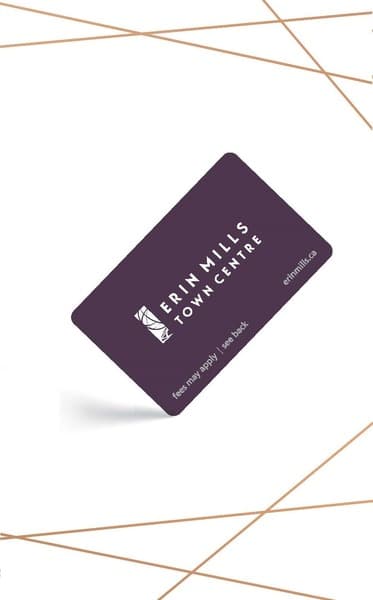
Erin Mills Town Centre Gift Cards are the perfect choice for your gift giving needs.Purchase gift cards at kiosks near the food court or centre court, at Guest Services, or click below to purchase online.PURCHASE HERE
Indigo An Introduction to Diophantine Equations: A Problem-based Approach | Erin Mills Town Centre
*Product information may vary - to confirm product availability, pricing, shipping and return information please contact Indigo
This problem-solving book is an introduction to the study of Diophantine equations, a class of equations in which only integer solutions are allowed. The presentation features some classical Diophantine equations, including linear, Pythagorean, and some higher degree equations, as well as exponential Diophantine equations. Many of the selected exercises and problems are original or are presented with original solutions. An Introduction to Diophantine Equations: A Problem-Based Approach is intended for undergraduates, advanced high school students and teachers, mathematical contest participants - including Olympiad and Putnam competitors - as well as readers interested in essential mathematics. The work uniquely presents unconventional and non-routine examples, ideas, and techniques.
This problem-solving book is an introduction to the study of Diophantine equations, a class of equations in which only integer solutions are allowed. The presentation features some classical Diophantine equations, including linear, Pythagorean, and some higher degree equations, as well as exponential Diophantine equations. Many of the selected exercises and problems are original or are presented with original solutions. An Introduction to Diophantine Equations: A Problem-Based Approach is intended for undergraduates, advanced high school students and teachers, mathematical contest participants - including Olympiad and Putnam competitors - as well as readers interested in essential mathematics. The work uniquely presents unconventional and non-routine examples, ideas, and techniques.
The largest book retailer in Canada also offers toys, music, home décor, gifts and lifestyle products. What's Inside...Books, Magazines, CD’s and DVD’s, Toys and Gifts, Home Accents, Electronics, Baby’s and Children’s Section, Bath and Body, Kitchen and Bedroom, Stationary Located outside in the exterior plaza.