

GIVE THE PERFECT GIFT
Erin Mills Town Centre Gift Cards are the perfect choice for your gift giving needs.Purchase gift cards at kiosks near the food court or centre court, at Guest Services, or click below to purchase online.PURCHASE HEREHome
Equivariant Cohomology Algebraic Geometry
Indigo
Loading Inventory...
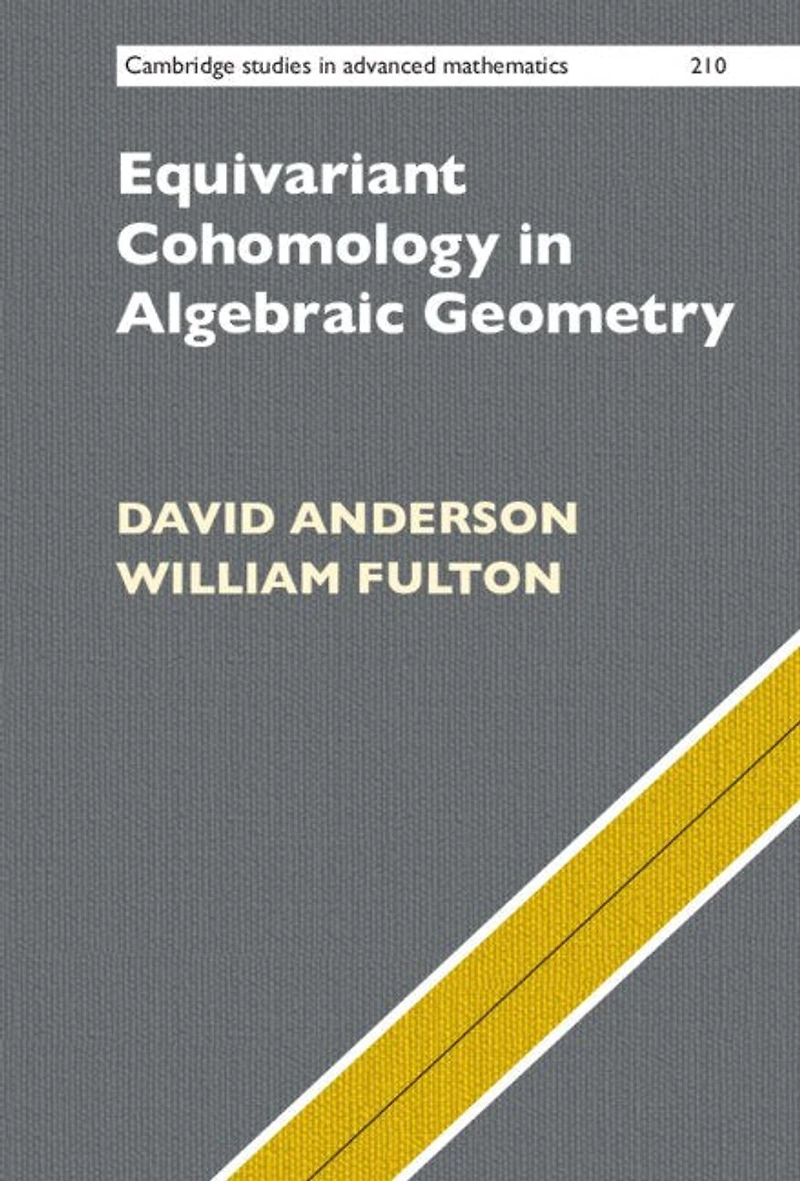
Equivariant Cohomology Algebraic Geometry
Current price: $77.95

Equivariant Cohomology Algebraic Geometry
Current price: $77.95
Loading Inventory...
Size: Hardcover
*Product information may vary - to confirm product availability, pricing, shipping and return information please contact Indigo
Equivariant cohomology has become an indispensable tool in algebraic geometry and in related areas including representation theory, combinatorial and enumerative geometry, and algebraic combinatorics. This text introduces the main ideas of the subject for first- or second-year graduate students in mathematics, as well as researchers working in algebraic geometry or combinatorics. The first six chapters cover the basics: definitions via finite-dimensional approximation spaces, computations in projective space, and the localization theorem. The rest of the text focuses on examples – toric varieties, Grassmannians, and homogeneous spaces – along with applications to Schubert calculus and degeneracy loci. Prerequisites are kept to a minimum, so that one-semester graduate-level courses in algebraic geometry and topology should be sufficient preparation. Featuring numerous exercises, examples, and material that has not previously appeared in textbook form, this book will be a must-have reference and resource for both students and researchers for years to come.
Equivariant cohomology has become an indispensable tool in algebraic geometry and in related areas including representation theory, combinatorial and enumerative geometry, and algebraic combinatorics. This text introduces the main ideas of the subject for first- or second-year graduate students in mathematics, as well as researchers working in algebraic geometry or combinatorics. The first six chapters cover the basics: definitions via finite-dimensional approximation spaces, computations in projective space, and the localization theorem. The rest of the text focuses on examples – toric varieties, Grassmannians, and homogeneous spaces – along with applications to Schubert calculus and degeneracy loci. Prerequisites are kept to a minimum, so that one-semester graduate-level courses in algebraic geometry and topology should be sufficient preparation. Featuring numerous exercises, examples, and material that has not previously appeared in textbook form, this book will be a must-have reference and resource for both students and researchers for years to come.
You May Also Like







More About Indigo at Erin Mills Town Centre
The largest book retailer in Canada also offers toys, music, home décor, gifts and lifestyle products. What's Inside...Books, Magazines, CD’s and DVD’s, Toys and Gifts, Home Accents, Electronics, Baby’s and Children’s Section, Bath and Body, Kitchen and Bedroom, Stationary Located outside in the exterior plaza.
5015 Glen Erin Dr, Mississauga, ON L5M 0R7, Canada
Find Indigo at Erin Mills Town Centre in Mississauga ON
Visit Indigo at Erin Mills Town Centre in Mississauga ON