

GIVE THE PERFECT GIFT
Erin Mills Town Centre Gift Cards are the perfect choice for your gift giving needs.Purchase gift cards at kiosks near the food court or centre court, at Guest Services, or click below to purchase online.PURCHASE HEREHome
15N-NMR Spectroscopy
Indigo
Loading Inventory...
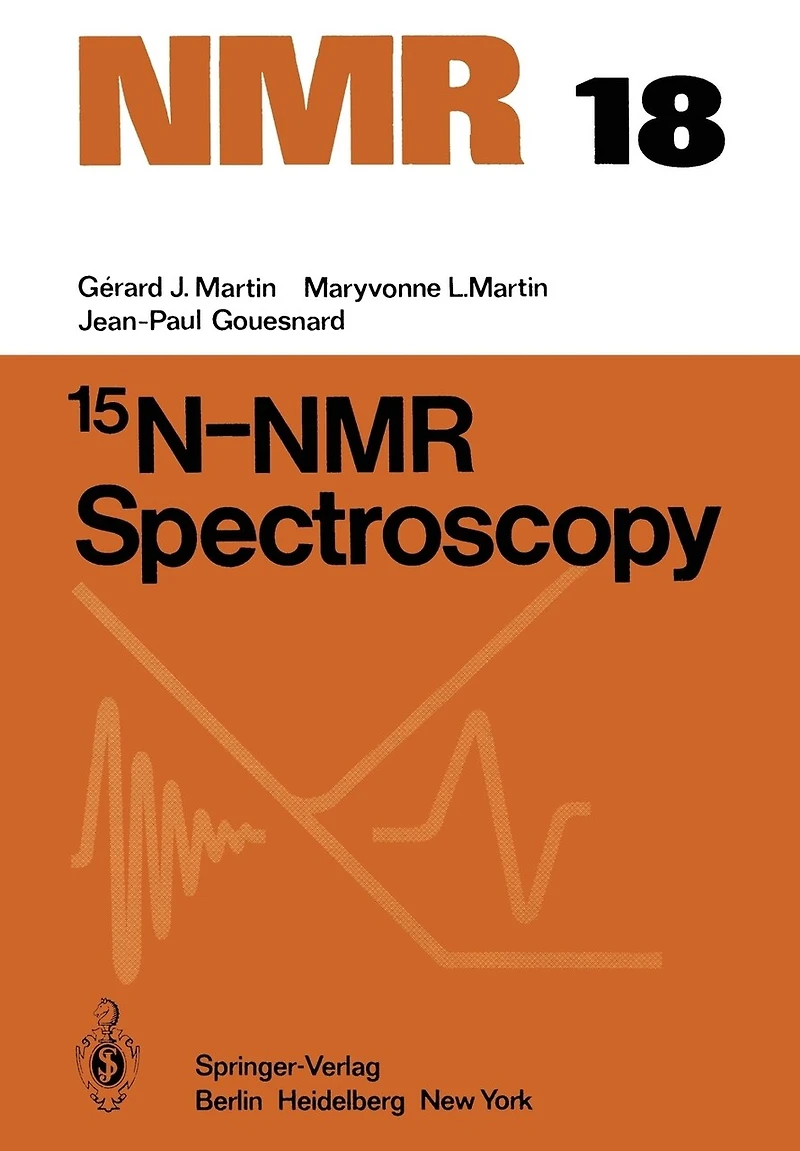
15N-NMR Spectroscopy
Current price: $142.95

15N-NMR Spectroscopy
Current price: $142.95
Loading Inventory...
Size: Paperback
*Product information may vary - to confirm product availability, pricing, shipping and return information please contact Indigo
After the proton and carbon, nitrogen is, with oxygen, the most impor- tant atom in organic and especially bioorganic molecules. However, the development of nitrogen spectroscopy is indeed very recent. This is due to the fact that nitrogen-14, which is the naturally abundant iso- tope, suffers, for structural studies, from the disadvantages inherent in nuclei with a quadrupolar moment (Table 1.1). Actually, indirect 15N measurements were reported in the early days of double resonance spectroscopy and the first direct detection of 15N resonance signals at the natural abundance level was realized in 1964 (R 17) at 4.33 MHz 1 ( 1T) using a 15 mm o.d. cell in the field sweep mode ( 0.16 min- ). Signal-to-noise ratios only of 3-4 were obtained for neat liquids and this low sensitivity of the 15N resonance still remains the main dis- advantage for 15 spectroscopy (Table 1.1). However, nitrogen-15 has, N probably more than any other nucleus, benefited from the advances of NMR technology, i.e. Fourier transformation, multinuclear facilities, wide-bore super conducting solenoids, and, with the new generation of spectrometers, 15N-NMR is entering the field of routine investigation. Nevertheless, in spite of these spectacular improvements, obtaining 15N spectra of diluted species or large biochemical molecules is often not very easy and a good knowledge of the relaxation properties pecu- liar to 15N may be necessary in order to adjust the pulse sequences and the decoupler duty cycle correctly (Section 2).
After the proton and carbon, nitrogen is, with oxygen, the most impor- tant atom in organic and especially bioorganic molecules. However, the development of nitrogen spectroscopy is indeed very recent. This is due to the fact that nitrogen-14, which is the naturally abundant iso- tope, suffers, for structural studies, from the disadvantages inherent in nuclei with a quadrupolar moment (Table 1.1). Actually, indirect 15N measurements were reported in the early days of double resonance spectroscopy and the first direct detection of 15N resonance signals at the natural abundance level was realized in 1964 (R 17) at 4.33 MHz 1 ( 1T) using a 15 mm o.d. cell in the field sweep mode ( 0.16 min- ). Signal-to-noise ratios only of 3-4 were obtained for neat liquids and this low sensitivity of the 15N resonance still remains the main dis- advantage for 15 spectroscopy (Table 1.1). However, nitrogen-15 has, N probably more than any other nucleus, benefited from the advances of NMR technology, i.e. Fourier transformation, multinuclear facilities, wide-bore super conducting solenoids, and, with the new generation of spectrometers, 15N-NMR is entering the field of routine investigation. Nevertheless, in spite of these spectacular improvements, obtaining 15N spectra of diluted species or large biochemical molecules is often not very easy and a good knowledge of the relaxation properties pecu- liar to 15N may be necessary in order to adjust the pulse sequences and the decoupler duty cycle correctly (Section 2).
You May Also Like








More About Indigo at Erin Mills Town Centre
The largest book retailer in Canada also offers toys, music, home décor, gifts and lifestyle products. What's Inside...Books, Magazines, CD’s and DVD’s, Toys and Gifts, Home Accents, Electronics, Baby’s and Children’s Section, Bath and Body, Kitchen and Bedroom, Stationary Located outside in the exterior plaza.
5015 Glen Erin Dr, Mississauga, ON L5M 0R7, Canada
Find Indigo at Erin Mills Town Centre in Mississauga ON
Visit Indigo at Erin Mills Town Centre in Mississauga ON