

GIVE THE PERFECT GIFT
Erin Mills Town Centre Gift Cards are the perfect choice for your gift giving needs.Purchase gift cards at kiosks near the food court or centre court, at Guest Services, or click below to purchase online.PURCHASE HEREHome
A Combinatorial Approach to Matrix Theory and Its Applications
Indigo
Loading Inventory...
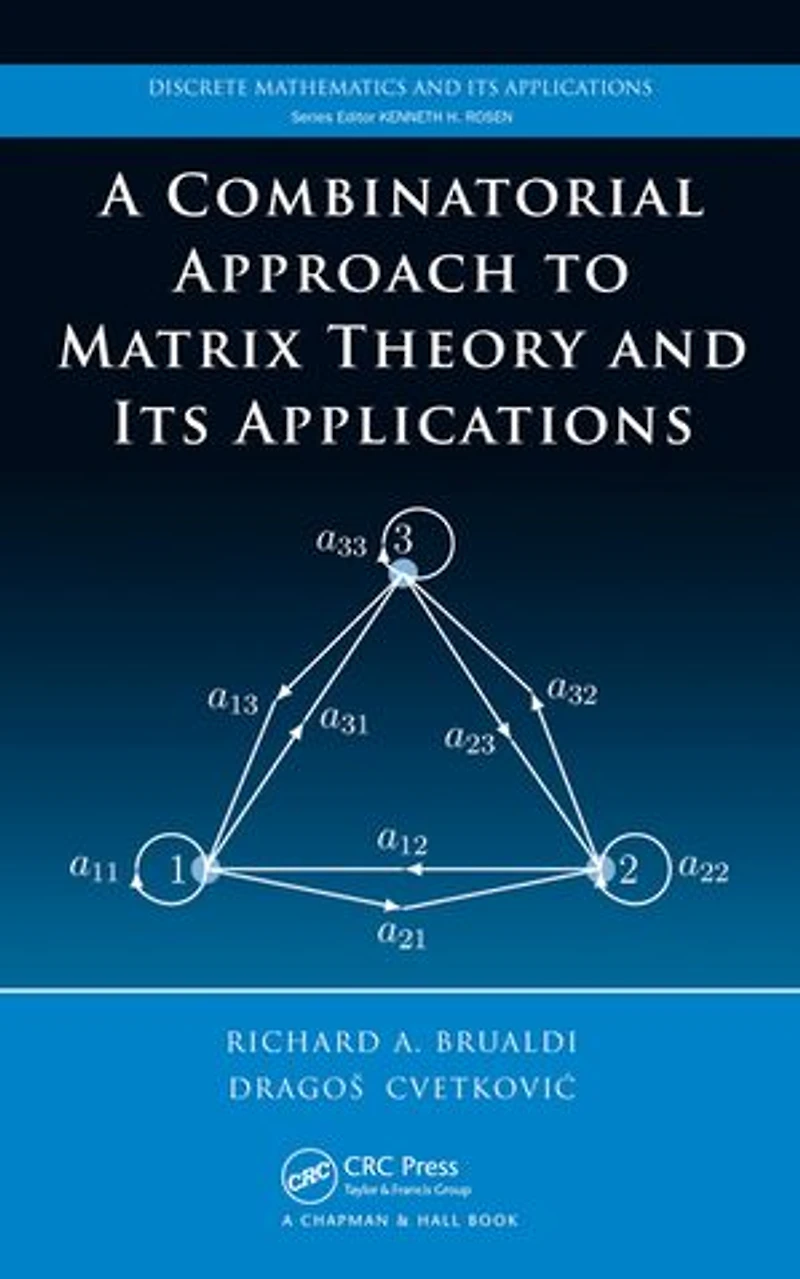
A Combinatorial Approach to Matrix Theory and Its Applications
Current price: $100.42

A Combinatorial Approach to Matrix Theory and Its Applications
Current price: $100.42
Loading Inventory...
Size: Kobo eBook
*Product information may vary - to confirm product availability, pricing, shipping and return information please contact Indigo
Unlike most elementary books on matrices, A Combinatorial Approach to Matrix Theory and Its Applications employs combinatorial and graph-theoretical tools to develop basic theorems of matrix theory, shedding new light on the subject by exploring the connections of these tools to matrices. Placing combinatorial and graph-theoretical tools at the forefront of the development of matrix theory, this book uses graphs to explain basic matrix construction, formulas, computations, ideas, and results. It presents material rarely found in other books at this level, including Gersgorin's theorem and its extensions, the Kronecker product of matrices, sign-nonsingular matrices, and the evaluation of the permanent matrix. The authors provide a combinatorial argument for the classical Cayley-Hamilton theorem and a combinatorial proof of the Jordan canonical form of a matrix. They also describe several applications of matrices in electrical engineering, physics, and chemistry.
Unlike most elementary books on matrices, A Combinatorial Approach to Matrix Theory and Its Applications employs combinatorial and graph-theoretical tools to develop basic theorems of matrix theory, shedding new light on the subject by exploring the connections of these tools to matrices. Placing combinatorial and graph-theoretical tools at the forefront of the development of matrix theory, this book uses graphs to explain basic matrix construction, formulas, computations, ideas, and results. It presents material rarely found in other books at this level, including Gersgorin's theorem and its extensions, the Kronecker product of matrices, sign-nonsingular matrices, and the evaluation of the permanent matrix. The authors provide a combinatorial argument for the classical Cayley-Hamilton theorem and a combinatorial proof of the Jordan canonical form of a matrix. They also describe several applications of matrices in electrical engineering, physics, and chemistry.
You May Also Like










More About Indigo at Erin Mills Town Centre
The largest book retailer in Canada also offers toys, music, home décor, gifts and lifestyle products. What's Inside...Books, Magazines, CD’s and DVD’s, Toys and Gifts, Home Accents, Electronics, Baby’s and Children’s Section, Bath and Body, Kitchen and Bedroom, Stationary Located outside in the exterior plaza.
5015 Glen Erin Dr, Mississauga, ON L5M 0R7, Canada
Find Indigo at Erin Mills Town Centre in Mississauga ON
Visit Indigo at Erin Mills Town Centre in Mississauga ON