

GIVE THE PERFECT GIFT
Erin Mills Town Centre Gift Cards are the perfect choice for your gift giving needs.Purchase gift cards at kiosks near the food court or centre court, at Guest Services, or click below to purchase online.PURCHASE HEREHome
A Computational Phonology of Russian
Indigo
Loading Inventory...
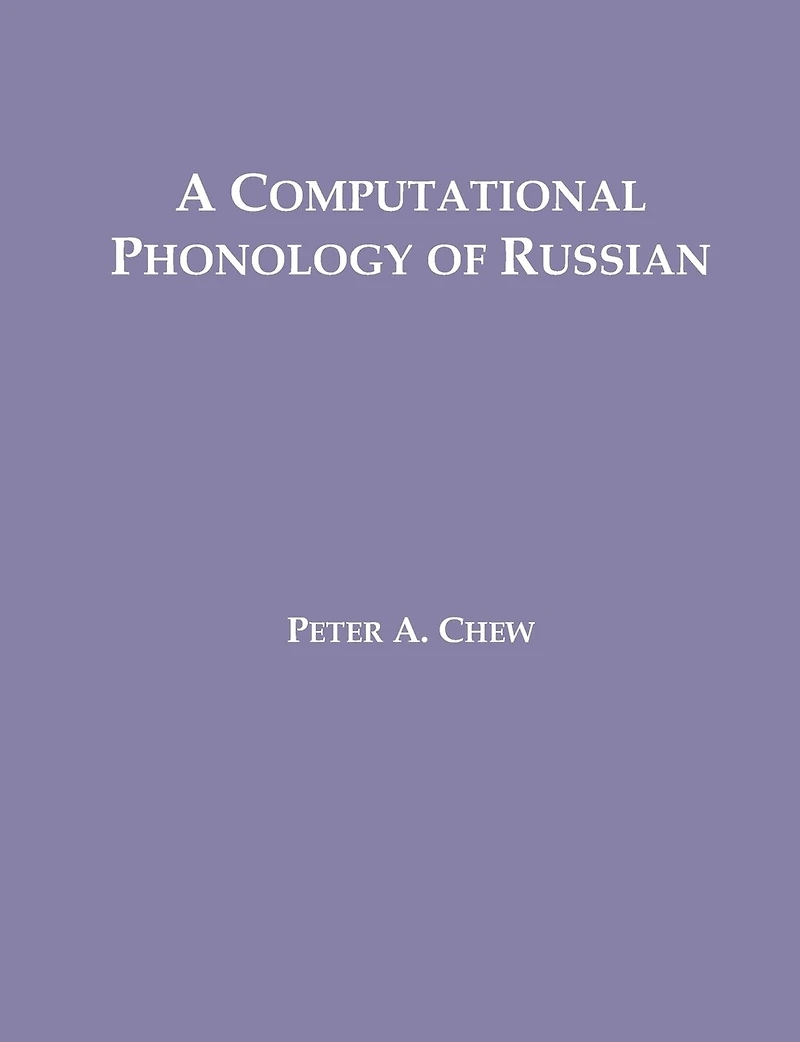
A Computational Phonology of Russian
Current price: $79.95

A Computational Phonology of Russian
Current price: $79.95
Loading Inventory...
Size: Paperback
*Product information may vary - to confirm product availability, pricing, shipping and return information please contact Indigo
This dissertation provides a coherent, synchronic, broad-coverage, generative phonology of Russian. I test the grammar empirically in a number of ways to determine its goodness of fit to Russian. In taking this approach, I aim to avoid making untested (or even incoherent) generalizations based on only a handful of examples. In most cases, the tests show that there are exceptions to the theory, but at least we know what the exceptions are, a baseline is set against which future theories can be measured, and in most cases the percentage of exceptional cases is reduced to below 5%. The principal theoretical outcomes of the work are as follows. First, I show that all of the phonological or morphophonological processes reviewed can be described by a grammar no more powerful than context-free. Secondly, I exploit probabilistic constraints in the syllable structure grammar to explain why constraints on word-marginal onsets and codas are weaker than on word-internal onsets and codas. I argue that the features ]/- initial] and ]/- final], and extraprosodicity, are unnecessary for this purpose.
This dissertation provides a coherent, synchronic, broad-coverage, generative phonology of Russian. I test the grammar empirically in a number of ways to determine its goodness of fit to Russian. In taking this approach, I aim to avoid making untested (or even incoherent) generalizations based on only a handful of examples. In most cases, the tests show that there are exceptions to the theory, but at least we know what the exceptions are, a baseline is set against which future theories can be measured, and in most cases the percentage of exceptional cases is reduced to below 5%. The principal theoretical outcomes of the work are as follows. First, I show that all of the phonological or morphophonological processes reviewed can be described by a grammar no more powerful than context-free. Secondly, I exploit probabilistic constraints in the syllable structure grammar to explain why constraints on word-marginal onsets and codas are weaker than on word-internal onsets and codas. I argue that the features ]/- initial] and ]/- final], and extraprosodicity, are unnecessary for this purpose.
You May Also Like







More About Indigo at Erin Mills Town Centre
The largest book retailer in Canada also offers toys, music, home décor, gifts and lifestyle products. What's Inside...Books, Magazines, CD’s and DVD’s, Toys and Gifts, Home Accents, Electronics, Baby’s and Children’s Section, Bath and Body, Kitchen and Bedroom, Stationary Located outside in the exterior plaza.
5015 Glen Erin Dr, Mississauga, ON L5M 0R7, Canada
Find Indigo at Erin Mills Town Centre in Mississauga ON
Visit Indigo at Erin Mills Town Centre in Mississauga ON