

GIVE THE PERFECT GIFT
Erin Mills Town Centre Gift Cards are the perfect choice for your gift giving needs.Purchase gift cards at kiosks near the food court or centre court, at Guest Services, or click below to purchase online.PURCHASE HEREHome
Abstract Chiral Polytopes
Indigo
Loading Inventory...
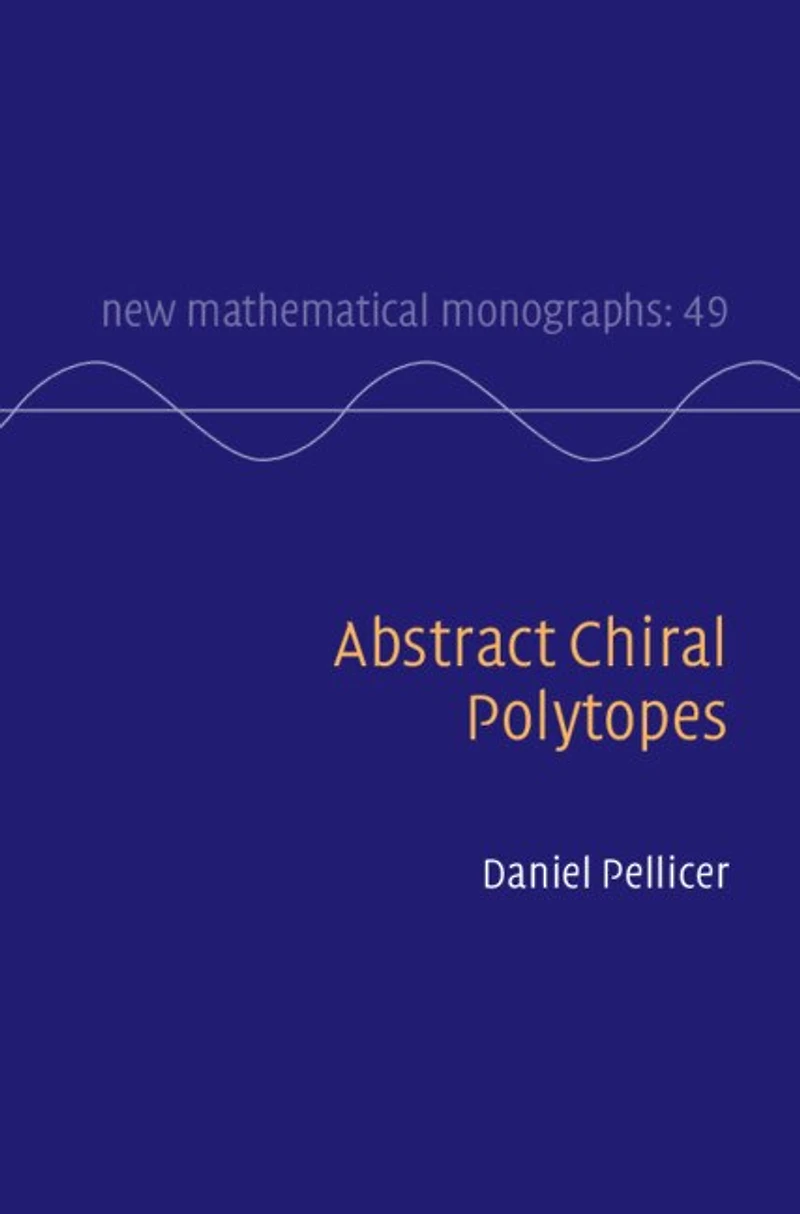
Abstract Chiral Polytopes
Current price: $206.95

Abstract Chiral Polytopes
Current price: $206.95
Loading Inventory...
Size: Hardcover
*Product information may vary - to confirm product availability, pricing, shipping and return information please contact Indigo
Abstract polytopes are partially ordered sets that satisfy some key aspects of the face lattices of convex polytopes. They are chiral if they have maximal symmetry by combinatorial rotations, but none by combinatorial reflections. Aimed at graduate students and researchers in combinatorics, group theory or Euclidean geometry, this text gives a self-contained introduction to abstract polytopes and specialises in chiral abstract polytopes. The first three chapters are introductory and mostly contain basic concepts and results. The fourth chapter talks about ways to obtain chiral abstract polytopes from other abstract polytopes, while the fifth discusses families of chiral polytopes grouped by common properties such as their rank, their small size or their geometric origin. Finally, the last chapter relates chiral polytopes with geometric objects in Euclidean spaces. This material is complemented by a number of examples, exercises and figures, and a list of 75 open problems to inspire further research.
Abstract polytopes are partially ordered sets that satisfy some key aspects of the face lattices of convex polytopes. They are chiral if they have maximal symmetry by combinatorial rotations, but none by combinatorial reflections. Aimed at graduate students and researchers in combinatorics, group theory or Euclidean geometry, this text gives a self-contained introduction to abstract polytopes and specialises in chiral abstract polytopes. The first three chapters are introductory and mostly contain basic concepts and results. The fourth chapter talks about ways to obtain chiral abstract polytopes from other abstract polytopes, while the fifth discusses families of chiral polytopes grouped by common properties such as their rank, their small size or their geometric origin. Finally, the last chapter relates chiral polytopes with geometric objects in Euclidean spaces. This material is complemented by a number of examples, exercises and figures, and a list of 75 open problems to inspire further research.
You May Also Like








More About Indigo at Erin Mills Town Centre
The largest book retailer in Canada also offers toys, music, home décor, gifts and lifestyle products. What's Inside...Books, Magazines, CD’s and DVD’s, Toys and Gifts, Home Accents, Electronics, Baby’s and Children’s Section, Bath and Body, Kitchen and Bedroom, Stationary Located outside in the exterior plaza.
5015 Glen Erin Dr, Mississauga, ON L5M 0R7, Canada
Find Indigo at Erin Mills Town Centre in Mississauga ON
Visit Indigo at Erin Mills Town Centre in Mississauga ON