

GIVE THE PERFECT GIFT
Erin Mills Town Centre Gift Cards are the perfect choice for your gift giving needs.Purchase gift cards at kiosks near the food court or centre court, at Guest Services, or click below to purchase online.PURCHASE HEREHome
Advanced Calculus for Economics and Finance: Theory Methods
Indigo
Loading Inventory...
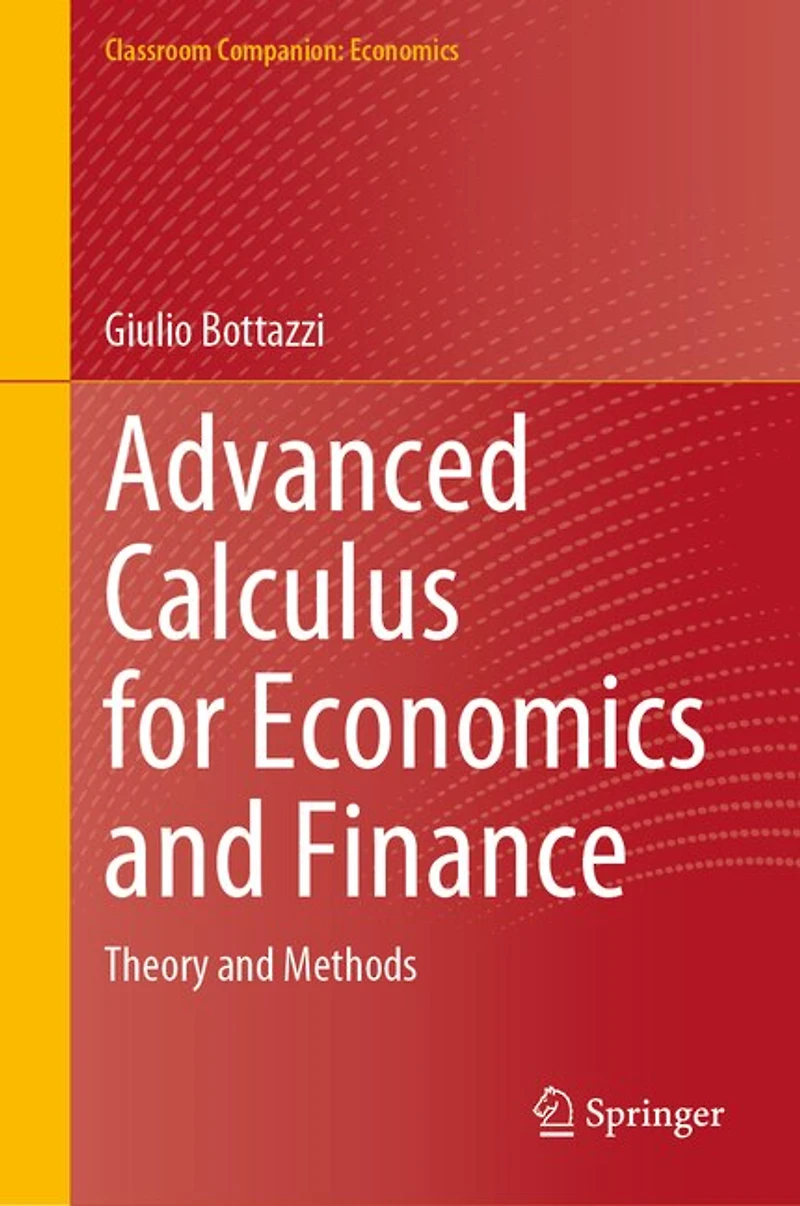
Advanced Calculus for Economics and Finance: Theory Methods
Current price: $131.50

Advanced Calculus for Economics and Finance: Theory Methods
Current price: $131.50
Loading Inventory...
Size: Hardcover
*Product information may vary - to confirm product availability, pricing, shipping and return information please contact Indigo
This textbook provides a comprehensive introduction to mathematical calculus. Written for advanced undergraduate and graduate students, it teaches the fundamental mathematical concepts, methods and tools required for various areas of economics and the social sciences, such as optimization and measure theory. The reader will be introduced to topological, metric and normed spaces, learning about numerical sequences, series, and differential and integral calculus. These concepts are introduced using the axiomatic approach as a tool for logical reasoning, consistency, and formalization of ideas. The book follows a theorem-proving approach, stressing the limitations of applying the different theorems, while providing thought-provoking counter-examples. Each chapter features exercises that facilitate learning and allow students to apply and test important concepts and tools.
This textbook provides a comprehensive introduction to mathematical calculus. Written for advanced undergraduate and graduate students, it teaches the fundamental mathematical concepts, methods and tools required for various areas of economics and the social sciences, such as optimization and measure theory. The reader will be introduced to topological, metric and normed spaces, learning about numerical sequences, series, and differential and integral calculus. These concepts are introduced using the axiomatic approach as a tool for logical reasoning, consistency, and formalization of ideas. The book follows a theorem-proving approach, stressing the limitations of applying the different theorems, while providing thought-provoking counter-examples. Each chapter features exercises that facilitate learning and allow students to apply and test important concepts and tools.
You May Also Like








More About Indigo at Erin Mills Town Centre
The largest book retailer in Canada also offers toys, music, home décor, gifts and lifestyle products. What's Inside...Books, Magazines, CD’s and DVD’s, Toys and Gifts, Home Accents, Electronics, Baby’s and Children’s Section, Bath and Body, Kitchen and Bedroom, Stationary Located outside in the exterior plaza.
5015 Glen Erin Dr, Mississauga, ON L5M 0R7, Canada
Find Indigo at Erin Mills Town Centre in Mississauga ON
Visit Indigo at Erin Mills Town Centre in Mississauga ON