

GIVE THE PERFECT GIFT
Erin Mills Town Centre Gift Cards are the perfect choice for your gift giving needs.Purchase gift cards at kiosks near the food court or centre court, at Guest Services, or click below to purchase online.PURCHASE HEREHome
Applied Multivariate Analysis
Indigo
Loading Inventory...
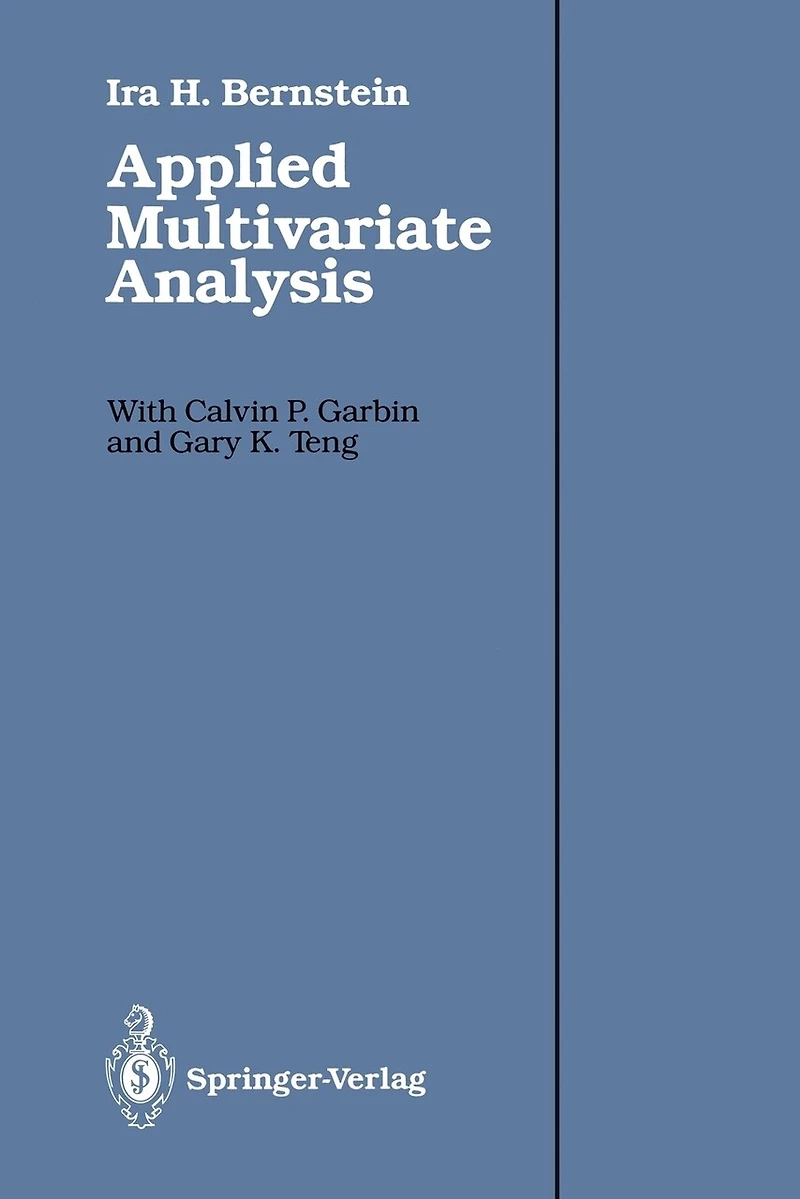
Applied Multivariate Analysis
Current price: $131.50

Applied Multivariate Analysis
Current price: $131.50
Loading Inventory...
Size: Paperback
*Product information may vary - to confirm product availability, pricing, shipping and return information please contact Indigo
Like most academic authors, my views are a joint product of my teaching and my research. Needless to say, my views reflect the biases that I have acquired. One way to articulate the rationale (and limitations) of my biases is through the preface of a truly great text of a previous era, Cooley and Lohnes (1971, p. v). They draw a distinction between mathematical statisticians whose intel lect gave birth to the field of multivariate analysis, such as Hotelling, Bartlett, and Wilks, and those who chose to "concentrate much of their attention on methods of analyzing data in the sciences and of interpreting the results of statistical analysis . . . . (and) . . . who are more interested in the sciences than in mathematics, among other characteristics. " I find the distinction between individuals who are temperamentally "mathe maticians" (whom philosophy students might call "Platonists") and "scientists" ("Aristotelians") useful as long as it is not pushed to the point where one assumes "mathematicians" completely disdain data and "scientists" are never interested in contributing to the mathematical foundations of their discipline. I certainly feel more comfortable attempting to contribute in the "scientist" rather than the "mathematician" role. As a consequence, this book is primarily written for individuals concerned with data analysis. However, as noted in Chapter 1, true expertise demands familiarity with both traditions.
Like most academic authors, my views are a joint product of my teaching and my research. Needless to say, my views reflect the biases that I have acquired. One way to articulate the rationale (and limitations) of my biases is through the preface of a truly great text of a previous era, Cooley and Lohnes (1971, p. v). They draw a distinction between mathematical statisticians whose intel lect gave birth to the field of multivariate analysis, such as Hotelling, Bartlett, and Wilks, and those who chose to "concentrate much of their attention on methods of analyzing data in the sciences and of interpreting the results of statistical analysis . . . . (and) . . . who are more interested in the sciences than in mathematics, among other characteristics. " I find the distinction between individuals who are temperamentally "mathe maticians" (whom philosophy students might call "Platonists") and "scientists" ("Aristotelians") useful as long as it is not pushed to the point where one assumes "mathematicians" completely disdain data and "scientists" are never interested in contributing to the mathematical foundations of their discipline. I certainly feel more comfortable attempting to contribute in the "scientist" rather than the "mathematician" role. As a consequence, this book is primarily written for individuals concerned with data analysis. However, as noted in Chapter 1, true expertise demands familiarity with both traditions.
You May Also Like








More About Indigo at Erin Mills Town Centre
The largest book retailer in Canada also offers toys, music, home décor, gifts and lifestyle products. What's Inside...Books, Magazines, CD’s and DVD’s, Toys and Gifts, Home Accents, Electronics, Baby’s and Children’s Section, Bath and Body, Kitchen and Bedroom, Stationary Located outside in the exterior plaza.
5015 Glen Erin Dr, Mississauga, ON L5M 0R7, Canada
Find Indigo at Erin Mills Town Centre in Mississauga ON
Visit Indigo at Erin Mills Town Centre in Mississauga ON