

GIVE THE PERFECT GIFT
Erin Mills Town Centre Gift Cards are the perfect choice for your gift giving needs.Purchase gift cards at kiosks near the food court or centre court, at Guest Services, or click below to purchase online.PURCHASE HEREHome
Appraisal Approach to Conflict Styles: Computational Mapping of Disputant's Attitudinal Disposition Patterns Family Mediations
Indigo
Loading Inventory...

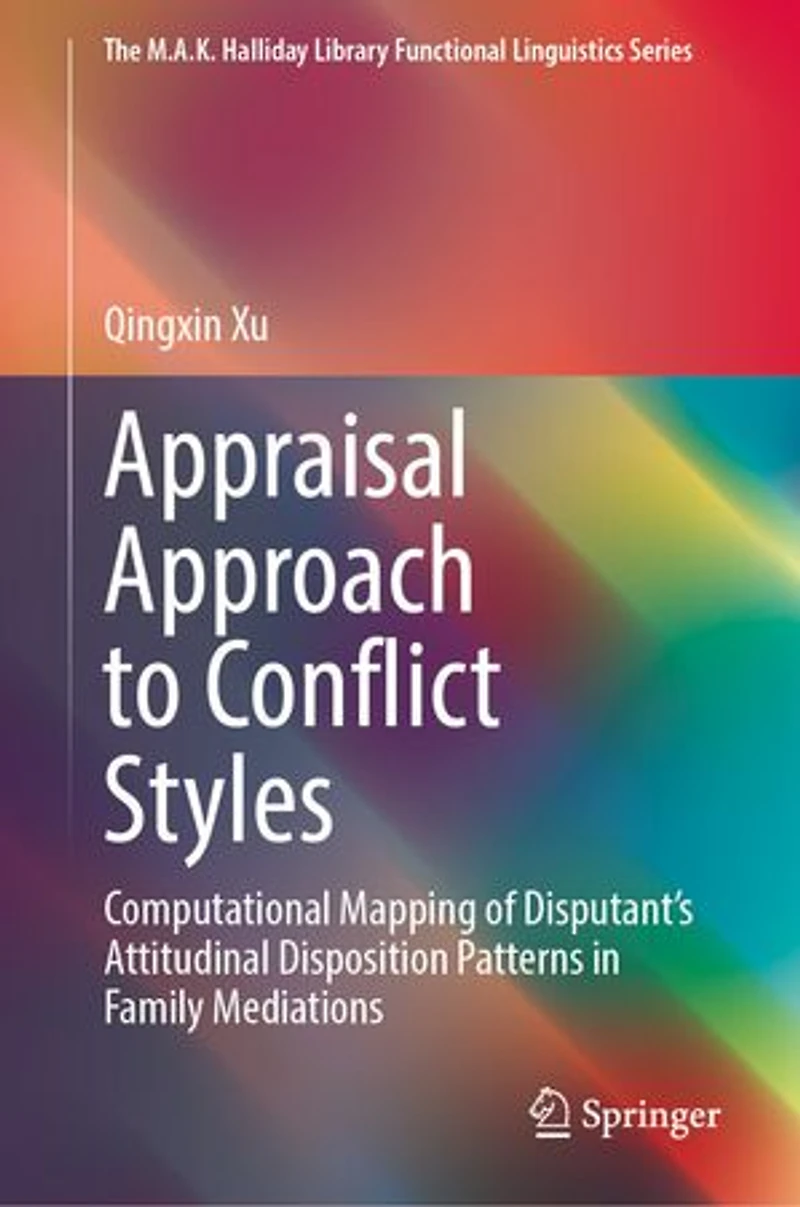
Appraisal Approach to Conflict Styles: Computational Mapping of Disputant's Attitudinal Disposition Patterns Family Mediations
Current price: $189.95

Appraisal Approach to Conflict Styles: Computational Mapping of Disputant's Attitudinal Disposition Patterns Family Mediations
Current price: $189.95
Loading Inventory...
Size: Hardcover
*Product information may vary - to confirm product availability, pricing, shipping and return information please contact Indigo
This book contributes to the existing Systemic Functional Linguistics (SFL) literature in several ways. It expands SFL&s empirical scope to understudied, high-stakes institutional contexts like mediation, enriching our understanding of register and genre. Methodologically, this research bridges computational data mining with SFL&s meaning-oriented tradition, providing a solution to the ‘delicacy vs. scale& dilemma which is capable of handling large-scale conversational data while preserving linguistic and sociological insights. Furthermore, the research extends existing SFL/Appraisal-based identity studies by tracking the co-occurrences of all evaluative options within the Appraisal system network, systematically mapping the relationship between the reservoir of meanings in a culture and the repertoire a given individual can mobilize, as well as the relationship between the reservoir of systems populating the realization hierarchy and their actualization in text. Targeted at scholars in linguistics, discourse analysis, communication studies, and computational social sciences, this book offers a sophisticated understanding of how language functions as a dynamic tool for identity negotiation. It provides researchers and practitioners with innovative theoretical frameworks and methodological approaches for analysing discursive behaviours in high-conflict interactions. This book also provides practical insights for mediation practitioners, demonstrating how language can be strategically employed to facilitate more effective communication and resolution strategies.
This book contributes to the existing Systemic Functional Linguistics (SFL) literature in several ways. It expands SFL&s empirical scope to understudied, high-stakes institutional contexts like mediation, enriching our understanding of register and genre. Methodologically, this research bridges computational data mining with SFL&s meaning-oriented tradition, providing a solution to the ‘delicacy vs. scale& dilemma which is capable of handling large-scale conversational data while preserving linguistic and sociological insights. Furthermore, the research extends existing SFL/Appraisal-based identity studies by tracking the co-occurrences of all evaluative options within the Appraisal system network, systematically mapping the relationship between the reservoir of meanings in a culture and the repertoire a given individual can mobilize, as well as the relationship between the reservoir of systems populating the realization hierarchy and their actualization in text. Targeted at scholars in linguistics, discourse analysis, communication studies, and computational social sciences, this book offers a sophisticated understanding of how language functions as a dynamic tool for identity negotiation. It provides researchers and practitioners with innovative theoretical frameworks and methodological approaches for analysing discursive behaviours in high-conflict interactions. This book also provides practical insights for mediation practitioners, demonstrating how language can be strategically employed to facilitate more effective communication and resolution strategies.
You May Also Like


















More About Indigo at Erin Mills Town Centre
The largest book retailer in Canada also offers toys, music, home décor, gifts and lifestyle products. What's Inside...Books, Magazines, CD’s and DVD’s, Toys and Gifts, Home Accents, Electronics, Baby’s and Children’s Section, Bath and Body, Kitchen and Bedroom, Stationary Located outside in the exterior plaza.
5015 Glen Erin Dr, Mississauga, ON L5M 0R7, Canada
Find Indigo at Erin Mills Town Centre in Mississauga ON
Visit Indigo at Erin Mills Town Centre in Mississauga ON