

GIVE THE PERFECT GIFT
Erin Mills Town Centre Gift Cards are the perfect choice for your gift giving needs.Purchase gift cards at kiosks near the food court or centre court, at Guest Services, or click below to purchase online.PURCHASE HEREHome
Athens & Democracy: Ancient Politics for Modern Times: Citizens, Assemblies, and Direct Governance in Classical Greece, 508-322 BCE
Indigo
Loading Inventory...
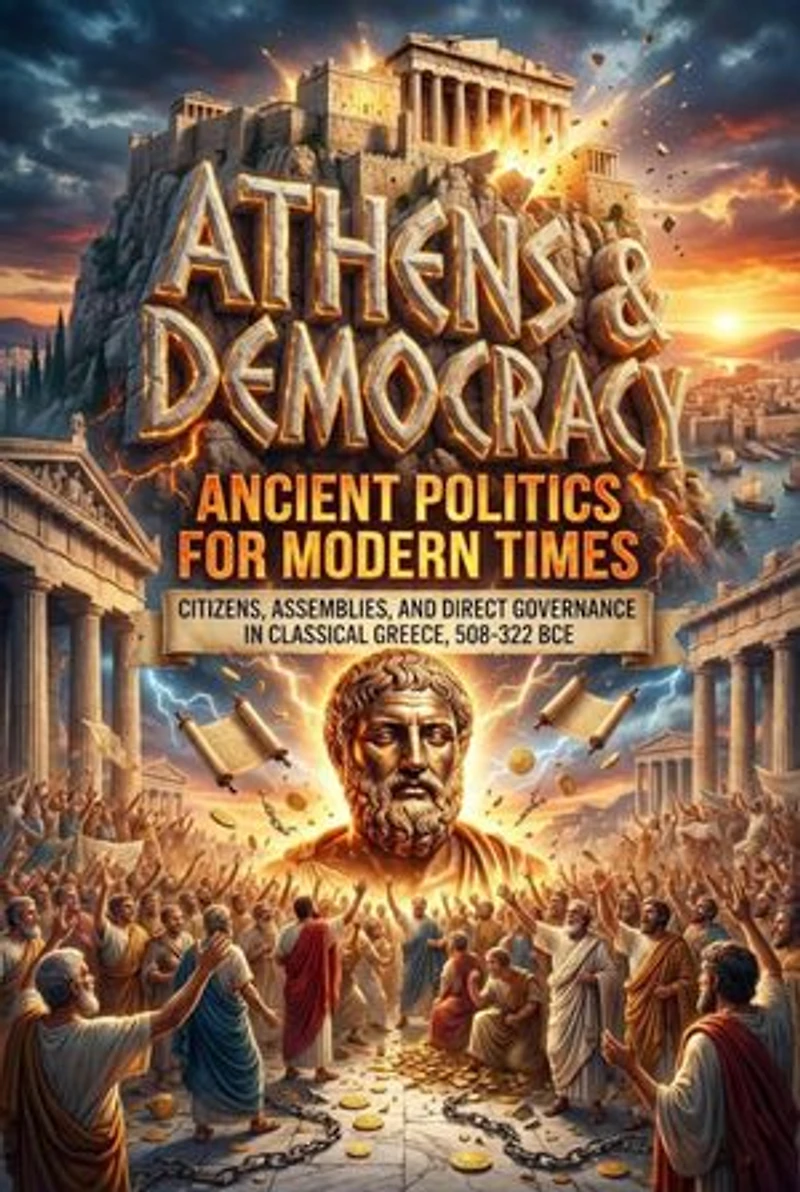
Athens & Democracy: Ancient Politics for Modern Times: Citizens, Assemblies, and Direct Governance in Classical Greece, 508-322 BCE
Current price: $14.99

Athens & Democracy: Ancient Politics for Modern Times: Citizens, Assemblies, and Direct Governance in Classical Greece, 508-322 BCE
Current price: $14.99
Loading Inventory...
Size: Kobo eBook
*Product information may vary - to confirm product availability, pricing, shipping and return information please contact Indigo
In 508 BCE, Athens launched history's first radical experiment in citizen rule—a system where ordinary people debated policy, voted on laws, and held magistrates accountable through public assembly. This examination of Athenian democracy reveals both its revolutionary achievements and its inherent contradictions, offering unexpected insights for contemporary political challenges. Drawing on archaeological findings, inscriptions, speeches, and philosophical texts, the narrative reconstructs how democratic institutions actually functioned. The Assembly gathered on the Pnyx hill where thousands of citizens argued foreign policy, declared war, and decided budgets. Juries of hundreds heard cases without professional judges. Officials were selected by lottery, not election, to prevent elite domination. Yet this participatory system excluded women, slaves, and foreigners—roughly 90% of Athens' population. The book traces democracy's evolution through Persian invasions, the Peloponnesian War, internal coups, and philosophical critiques from Plato and Aristotle. It examines how Athens balanced individual liberty with collective decision-making, managed populist pressures and elite influence, and confronted the tension between expertise and popular sovereignty—dilemmas strikingly familiar to modern democracies. Beyond idealized narratives, the analysis explores practical mechanisms: how debates were structured, how demagogues gained influence, how ostracism removed dangerous leaders, and why direct participation eventually gave way to representative systems. The Athenian experience illuminates persistent questions about citizenship, accountability, political education, and the fragility of democratic norms.
In 508 BCE, Athens launched history's first radical experiment in citizen rule—a system where ordinary people debated policy, voted on laws, and held magistrates accountable through public assembly. This examination of Athenian democracy reveals both its revolutionary achievements and its inherent contradictions, offering unexpected insights for contemporary political challenges. Drawing on archaeological findings, inscriptions, speeches, and philosophical texts, the narrative reconstructs how democratic institutions actually functioned. The Assembly gathered on the Pnyx hill where thousands of citizens argued foreign policy, declared war, and decided budgets. Juries of hundreds heard cases without professional judges. Officials were selected by lottery, not election, to prevent elite domination. Yet this participatory system excluded women, slaves, and foreigners—roughly 90% of Athens' population. The book traces democracy's evolution through Persian invasions, the Peloponnesian War, internal coups, and philosophical critiques from Plato and Aristotle. It examines how Athens balanced individual liberty with collective decision-making, managed populist pressures and elite influence, and confronted the tension between expertise and popular sovereignty—dilemmas strikingly familiar to modern democracies. Beyond idealized narratives, the analysis explores practical mechanisms: how debates were structured, how demagogues gained influence, how ostracism removed dangerous leaders, and why direct participation eventually gave way to representative systems. The Athenian experience illuminates persistent questions about citizenship, accountability, political education, and the fragility of democratic norms.
You May Also Like
![Life In Athens, In The Time Of Pericles, Illustrative Of Ancient And Modern Democracy. From The Germ. Of T.h. Von Wessenberg [sic]](https://cdn.mall.adeptmind.ai/https%253A%252F%252Fcdn.shopify.com%252Fs%252Ffiles%252F1%252F0655%252F8980%252F5233%252Ffiles%252F1_6c58aae2-941c-4650-a4b2-6e3a8b6a75db.jpg_medium.webp)












More About Indigo at Erin Mills Town Centre
The largest book retailer in Canada also offers toys, music, home décor, gifts and lifestyle products. What's Inside...Books, Magazines, CD’s and DVD’s, Toys and Gifts, Home Accents, Electronics, Baby’s and Children’s Section, Bath and Body, Kitchen and Bedroom, Stationary Located outside in the exterior plaza.
5015 Glen Erin Dr, Mississauga, ON L5M 0R7, Canada
Find Indigo at Erin Mills Town Centre in Mississauga ON
Visit Indigo at Erin Mills Town Centre in Mississauga ON