

GIVE THE PERFECT GIFT
Erin Mills Town Centre Gift Cards are the perfect choice for your gift giving needs.Purchase gift cards at kiosks near the food court or centre court, at Guest Services, or click below to purchase online.PURCHASE HEREHome
Big Events, Small Clauses: The Grammar of Elaboration
Indigo
Loading Inventory...
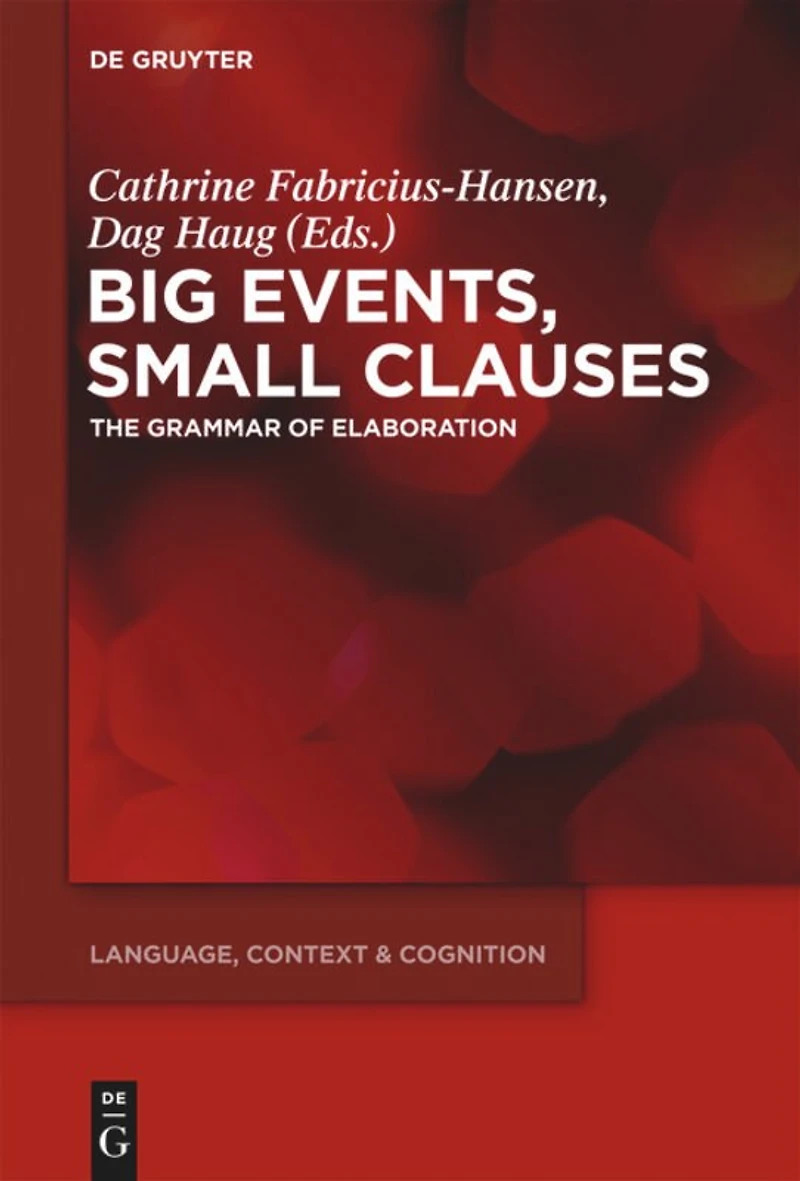
Big Events, Small Clauses: The Grammar of Elaboration
Current price: $438.99

Big Events, Small Clauses: The Grammar of Elaboration
Current price: $438.99
Loading Inventory...
Size: Hardcover
*Product information may vary - to confirm product availability, pricing, shipping and return information please contact Indigo
This book investigates specific syntactic means of event elaboration
across seven Indo-European languages (English, German, Norwegian,
French, Russian, Latin and Ancient Greek): bare and comitative small
clauses (“absolutes”), participle constructions and related clause-like but
non-finite adjuncts that increase descriptive granularity with respect to
constitutive parts of the matrix event (elaboration in the narrowest
sense), or describe eventualities that are co-located and connected
with but not part of the matrix event. The book falls in two
parts. Part I addresses central theoretical issues: How is the co-eventive
interpretation of such adjuncts achieved? What is the internal syntax of
participial and converb constructions? How do these constructions
function at the discourse level, as compared to various finite structures
that are available for co-eventive elaboration? Part II takes an empirical
cross-linguistic perspective. It consists of five self-contained chapters that
are based on parallel corpora and study either the use of a specific
construction across at least two of the seven object languages, or how a
specific construction is rendered in other languages.
This book investigates specific syntactic means of event elaboration
across seven Indo-European languages (English, German, Norwegian,
French, Russian, Latin and Ancient Greek): bare and comitative small
clauses (“absolutes”), participle constructions and related clause-like but
non-finite adjuncts that increase descriptive granularity with respect to
constitutive parts of the matrix event (elaboration in the narrowest
sense), or describe eventualities that are co-located and connected
with but not part of the matrix event. The book falls in two
parts. Part I addresses central theoretical issues: How is the co-eventive
interpretation of such adjuncts achieved? What is the internal syntax of
participial and converb constructions? How do these constructions
function at the discourse level, as compared to various finite structures
that are available for co-eventive elaboration? Part II takes an empirical
cross-linguistic perspective. It consists of five self-contained chapters that
are based on parallel corpora and study either the use of a specific
construction across at least two of the seven object languages, or how a
specific construction is rendered in other languages.
You May Also Like









More About Indigo at Erin Mills Town Centre
The largest book retailer in Canada also offers toys, music, home décor, gifts and lifestyle products. What's Inside...Books, Magazines, CD’s and DVD’s, Toys and Gifts, Home Accents, Electronics, Baby’s and Children’s Section, Bath and Body, Kitchen and Bedroom, Stationary Located outside in the exterior plaza.
5015 Glen Erin Dr, Mississauga, ON L5M 0R7, Canada
Find Indigo at Erin Mills Town Centre in Mississauga ON
Visit Indigo at Erin Mills Town Centre in Mississauga ON