

GIVE THE PERFECT GIFT
Erin Mills Town Centre Gift Cards are the perfect choice for your gift giving needs.Purchase gift cards at kiosks near the food court or centre court, at Guest Services, or click below to purchase online.PURCHASE HEREHome
Computational Methods for Integrating Vision and Language
Indigo
Loading Inventory...
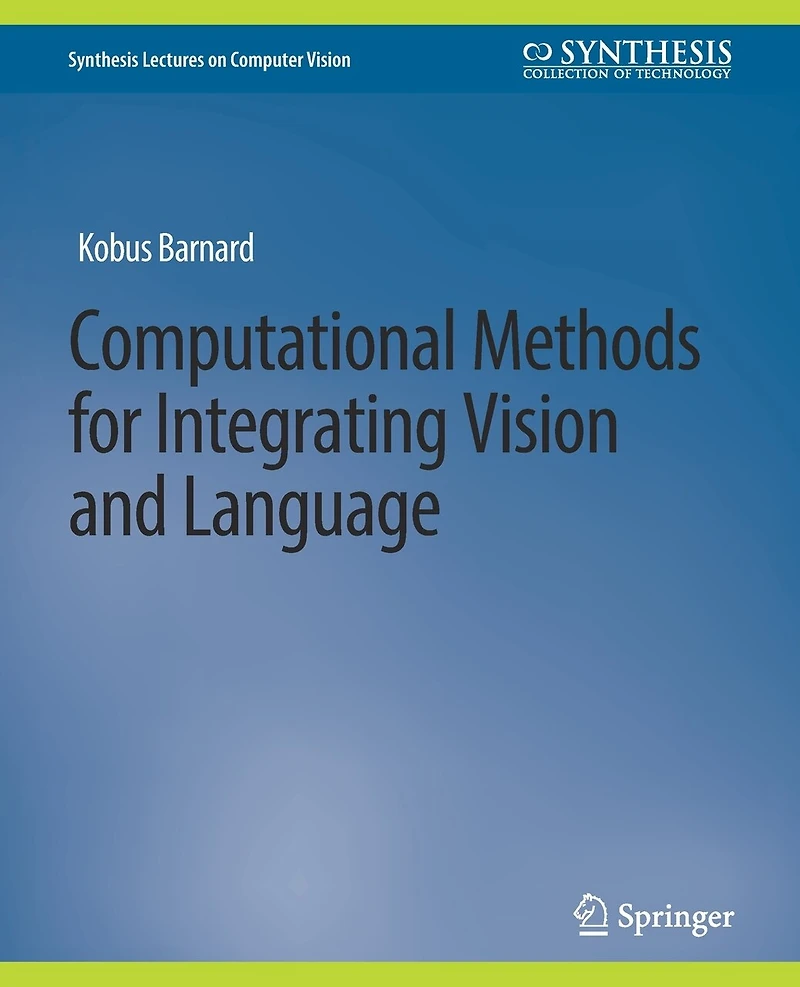
Computational Methods for Integrating Vision and Language
Current price: $71.50

Computational Methods for Integrating Vision and Language
Current price: $71.50
Loading Inventory...
Size: Paperback
*Product information may vary - to confirm product availability, pricing, shipping and return information please contact Indigo
Modeling data from visual and linguistic modalities together creates opportunities for better understanding of both, and supports many useful applications. Examples of dual visual-linguistic data includes images with keywords, video with narrative, and figures in documents. We consider two key task-driven themes: translating from one modality to another (e.g., inferring annotations for images) and understanding the data using all modalities, where one modality can help disambiguate information in another. The multiple modalities can either be essentially semantically redundant (e.g., keywords provided by a person looking at the image), or largely complementary (e.g., meta data such as the camera used). Redundancy and complementarity are two endpoints of a scale, and we observe that good performance on translation requires some redundancy, and that joint inference is most useful where some information is complementary. Computational methods discussed are broadly organized into ones forsimple keywords, ones going beyond keywords toward natural language, and ones considering sequential aspects of natural language. Methods for keywords are further organized based on localization of semantics, going from words about the scene taken as whole, to words that apply to specific parts of the scene, to relationships between parts. Methods going beyond keywords are organized by the linguistic roles that are learned, exploited, or generated. These include proper nouns, adjectives, spatial and comparative prepositions, and verbs. More recent developments in dealing with sequential structure include automated captioning of scenes and video, alignment of video and text, and automated answering of questions about scenes depicted in images.
Modeling data from visual and linguistic modalities together creates opportunities for better understanding of both, and supports many useful applications. Examples of dual visual-linguistic data includes images with keywords, video with narrative, and figures in documents. We consider two key task-driven themes: translating from one modality to another (e.g., inferring annotations for images) and understanding the data using all modalities, where one modality can help disambiguate information in another. The multiple modalities can either be essentially semantically redundant (e.g., keywords provided by a person looking at the image), or largely complementary (e.g., meta data such as the camera used). Redundancy and complementarity are two endpoints of a scale, and we observe that good performance on translation requires some redundancy, and that joint inference is most useful where some information is complementary. Computational methods discussed are broadly organized into ones forsimple keywords, ones going beyond keywords toward natural language, and ones considering sequential aspects of natural language. Methods for keywords are further organized based on localization of semantics, going from words about the scene taken as whole, to words that apply to specific parts of the scene, to relationships between parts. Methods going beyond keywords are organized by the linguistic roles that are learned, exploited, or generated. These include proper nouns, adjectives, spatial and comparative prepositions, and verbs. More recent developments in dealing with sequential structure include automated captioning of scenes and video, alignment of video and text, and automated answering of questions about scenes depicted in images.
You May Also Like










More About Indigo at Erin Mills Town Centre
The largest book retailer in Canada also offers toys, music, home décor, gifts and lifestyle products. What's Inside...Books, Magazines, CD’s and DVD’s, Toys and Gifts, Home Accents, Electronics, Baby’s and Children’s Section, Bath and Body, Kitchen and Bedroom, Stationary Located outside in the exterior plaza.
5015 Glen Erin Dr, Mississauga, ON L5M 0R7, Canada
Find Indigo at Erin Mills Town Centre in Mississauga ON
Visit Indigo at Erin Mills Town Centre in Mississauga ON