

GIVE THE PERFECT GIFT
Erin Mills Town Centre Gift Cards are the perfect choice for your gift giving needs.Purchase gift cards at kiosks near the food court or centre court, at Guest Services, or click below to purchase online.PURCHASE HEREHome
Dating the reigns of Xerxes I (496-475), Artaxerxes I (475-425) and Darius II (424-405)
Indigo
Loading Inventory...
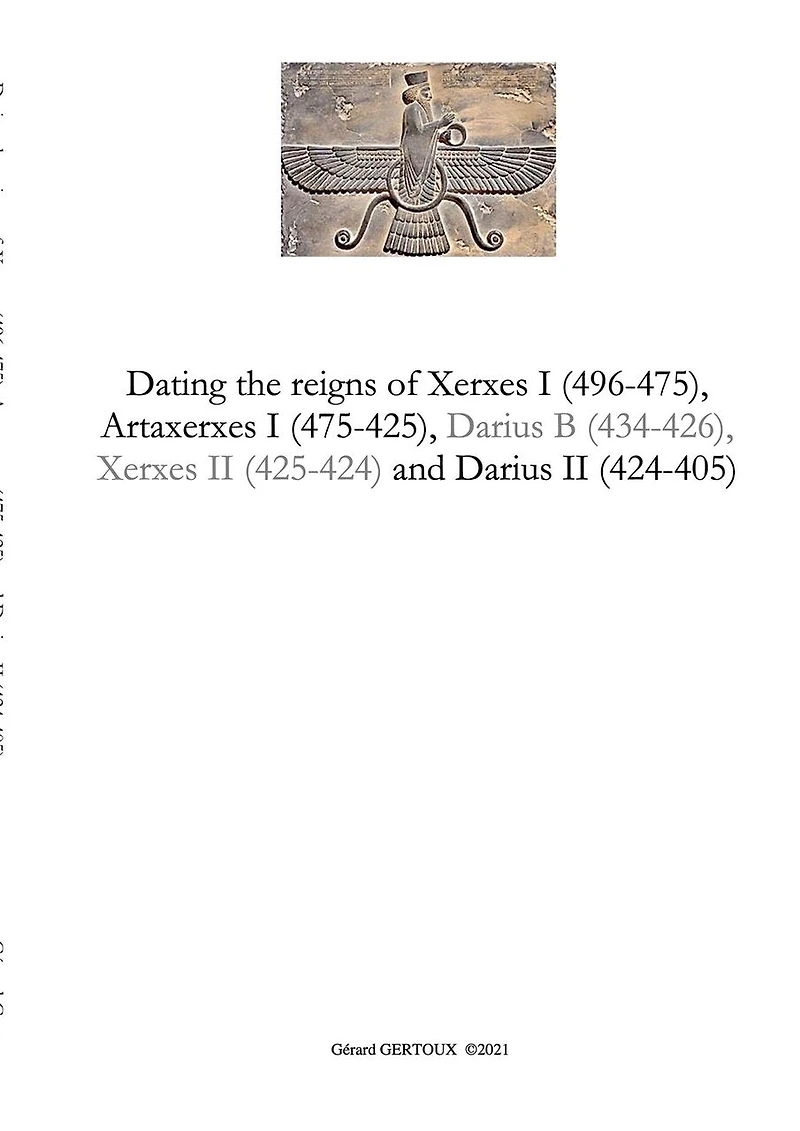
Dating the reigns of Xerxes I (496-475), Artaxerxes I (475-425) and Darius II (424-405)
Current price: $11.40

Dating the reigns of Xerxes I (496-475), Artaxerxes I (475-425) and Darius II (424-405)
Current price: $11.40
Loading Inventory...
Size: Paperback
*Product information may vary - to confirm product availability, pricing, shipping and return information please contact Indigo
The pivotal date of 465 BCE for the death of Xerxes has been accepted by historians for many years without notable controversy. However, according to Thucydides, a historian renowned for his high chronological accuracy, Themistocles met Artaxerxes, who had succeeded Xerxes, his father, just after the fall of Nexos (The Peloponnesian War I:98;137) which occurred after the fall of Skyros dated at the beginning of the archonship of Phaedo in 476 BCE, according to Plutarch (Life of Theseus §§35,36). Thus, the meeting with Themistocles would have occurred soon after 475 BCE, not 465. The present Achaemenid chronology comes mainly from official Babylonian king lists, which ignore coregents and usurpers. This official version is contradicted by contracts dated in "year, month, day" proving the existence of frequent co-regencies and usurpers. In addition, according to the astronomical tablet referenced BM 32234, the death of Xerxes is dated 14/V/21 between two lunar eclipses, one dated [14/III]/21 (26 June 475 BCE), which was total, and a second dated 14/VIII/21 (20 December 475 BCE), which was partial (in 465 BCE, the reverse happened). Thus, the death of Xerxes must be dated 24 August 475 BCE. Likewise, the death of Artaxerxes I is fixed precisely by Thucydides (The Peloponnesian War IV:50-52) just before a partial solar eclipse (21 March 424 BCE) which would imply an absurd co-regency of Darius II with a dead king for at least one year! In fact, Plutarch and Justinus effectively described a long co-regency of Artaxerxes but with his first son Darius B (434-426), not Darius II, and afterward two short reigns: Xerxes II (425-424) for 2 months then Sogdianus for 7 months, which occurred before the reign of Darius II. The arrangement of the intercalary months in a chronology without co-regency has several anomalies, especially the presence of two months Ulul in a single cycle. By contrast, in a chronology with co-regency, and thus two distinct cycles, the abnormal intercalary month in Year 30 of Darius (Persepolis) corresponds to another cycle ending in Year 4 of Xerxes. The titulature of Xerxes (496-475) in Egypt and the data of Diodorus confirm the co-regency of 10 years with Darius (522-486), as do Elephantine papyri with many double dates with civil and lunar calendars.
The pivotal date of 465 BCE for the death of Xerxes has been accepted by historians for many years without notable controversy. However, according to Thucydides, a historian renowned for his high chronological accuracy, Themistocles met Artaxerxes, who had succeeded Xerxes, his father, just after the fall of Nexos (The Peloponnesian War I:98;137) which occurred after the fall of Skyros dated at the beginning of the archonship of Phaedo in 476 BCE, according to Plutarch (Life of Theseus §§35,36). Thus, the meeting with Themistocles would have occurred soon after 475 BCE, not 465. The present Achaemenid chronology comes mainly from official Babylonian king lists, which ignore coregents and usurpers. This official version is contradicted by contracts dated in "year, month, day" proving the existence of frequent co-regencies and usurpers. In addition, according to the astronomical tablet referenced BM 32234, the death of Xerxes is dated 14/V/21 between two lunar eclipses, one dated [14/III]/21 (26 June 475 BCE), which was total, and a second dated 14/VIII/21 (20 December 475 BCE), which was partial (in 465 BCE, the reverse happened). Thus, the death of Xerxes must be dated 24 August 475 BCE. Likewise, the death of Artaxerxes I is fixed precisely by Thucydides (The Peloponnesian War IV:50-52) just before a partial solar eclipse (21 March 424 BCE) which would imply an absurd co-regency of Darius II with a dead king for at least one year! In fact, Plutarch and Justinus effectively described a long co-regency of Artaxerxes but with his first son Darius B (434-426), not Darius II, and afterward two short reigns: Xerxes II (425-424) for 2 months then Sogdianus for 7 months, which occurred before the reign of Darius II. The arrangement of the intercalary months in a chronology without co-regency has several anomalies, especially the presence of two months Ulul in a single cycle. By contrast, in a chronology with co-regency, and thus two distinct cycles, the abnormal intercalary month in Year 30 of Darius (Persepolis) corresponds to another cycle ending in Year 4 of Xerxes. The titulature of Xerxes (496-475) in Egypt and the data of Diodorus confirm the co-regency of 10 years with Darius (522-486), as do Elephantine papyri with many double dates with civil and lunar calendars.
You May Also Like














More About Indigo at Erin Mills Town Centre
The largest book retailer in Canada also offers toys, music, home décor, gifts and lifestyle products. What's Inside...Books, Magazines, CD’s and DVD’s, Toys and Gifts, Home Accents, Electronics, Baby’s and Children’s Section, Bath and Body, Kitchen and Bedroom, Stationary Located outside in the exterior plaza.
5015 Glen Erin Dr, Mississauga, ON L5M 0R7, Canada
Find Indigo at Erin Mills Town Centre in Mississauga ON
Visit Indigo at Erin Mills Town Centre in Mississauga ON