

GIVE THE PERFECT GIFT
Erin Mills Town Centre Gift Cards are the perfect choice for your gift giving needs.Purchase gift cards at kiosks near the food court or centre court, at Guest Services, or click below to purchase online.PURCHASE HEREHome
Discovering Group Theory: A Transition To Advanced Mathematics
Indigo
Loading Inventory...
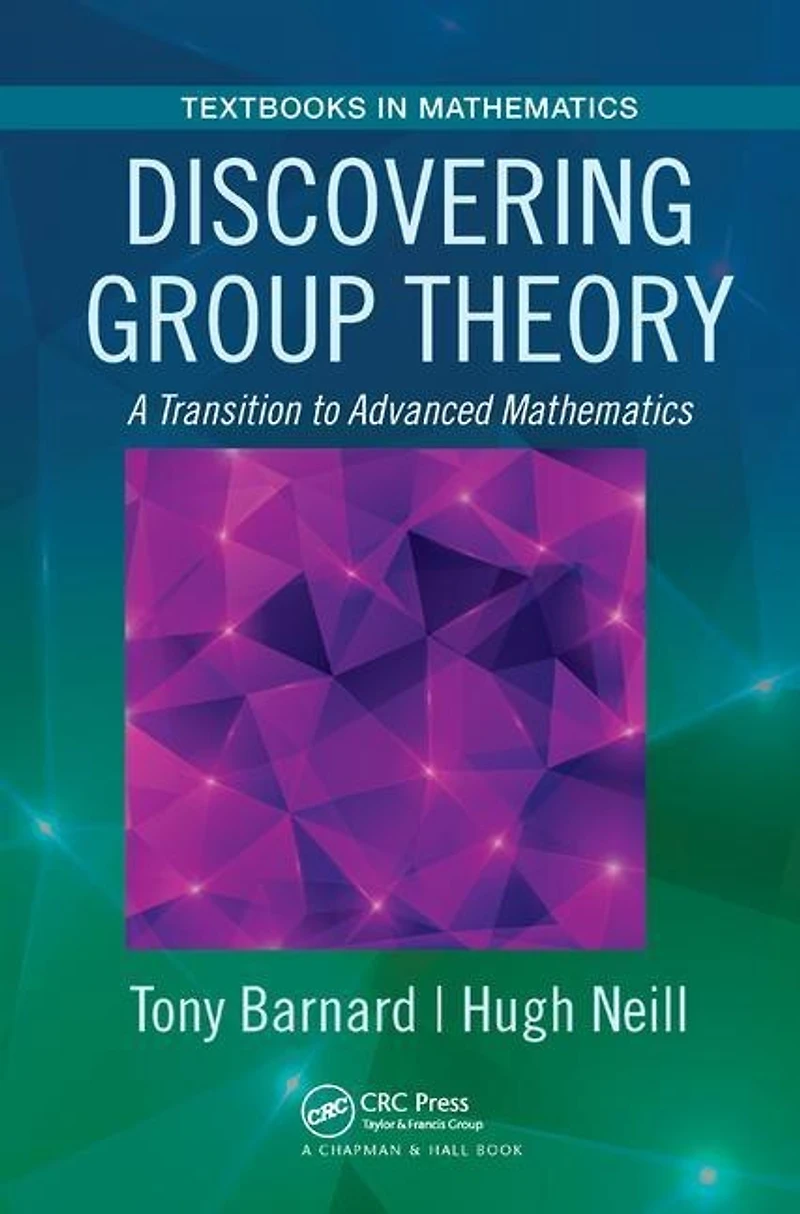
Discovering Group Theory: A Transition To Advanced Mathematics
Current price: $399.95

Discovering Group Theory: A Transition To Advanced Mathematics
Current price: $399.95
Loading Inventory...
Size: Hardcover
*Product information may vary - to confirm product availability, pricing, shipping and return information please contact Indigo
Discovering Group Theory: A Transition to Advanced Mathematics presents the usual material that is found in a first course on groups and then does a bit more. The book is intended for students who find the kind of reasoning in abstract mathematics courses unfamiliar and need extra support in this transition to advanced mathematics. The book gives a number of examples of groups and subgroups, including permutation groups, dihedral groups, and groups of integer residue classes. The book goes on to study cosets and finishes with the first isomorphism theorem. Very little is assumed as background knowledge on the part of the reader. Some facility in algebraic manipulation is required, and a working knowledge of some of the properties of integers, such as knowing how to factorize integers into prime factors. The book aims to help students with the transition from concrete to abstract mathematical thinking.
Discovering Group Theory: A Transition to Advanced Mathematics presents the usual material that is found in a first course on groups and then does a bit more. The book is intended for students who find the kind of reasoning in abstract mathematics courses unfamiliar and need extra support in this transition to advanced mathematics. The book gives a number of examples of groups and subgroups, including permutation groups, dihedral groups, and groups of integer residue classes. The book goes on to study cosets and finishes with the first isomorphism theorem. Very little is assumed as background knowledge on the part of the reader. Some facility in algebraic manipulation is required, and a working knowledge of some of the properties of integers, such as knowing how to factorize integers into prime factors. The book aims to help students with the transition from concrete to abstract mathematical thinking.
You May Also Like








More About Indigo at Erin Mills Town Centre
The largest book retailer in Canada also offers toys, music, home décor, gifts and lifestyle products. What's Inside...Books, Magazines, CD’s and DVD’s, Toys and Gifts, Home Accents, Electronics, Baby’s and Children’s Section, Bath and Body, Kitchen and Bedroom, Stationary Located outside in the exterior plaza.
5015 Glen Erin Dr, Mississauga, ON L5M 0R7, Canada
Find Indigo at Erin Mills Town Centre in Mississauga ON
Visit Indigo at Erin Mills Town Centre in Mississauga ON