

GIVE THE PERFECT GIFT
Erin Mills Town Centre Gift Cards are the perfect choice for your gift giving needs.Purchase gift cards at kiosks near the food court or centre court, at Guest Services, or click below to purchase online.PURCHASE HEREHome
Extreme Values Random Sequences
Indigo
Loading Inventory...
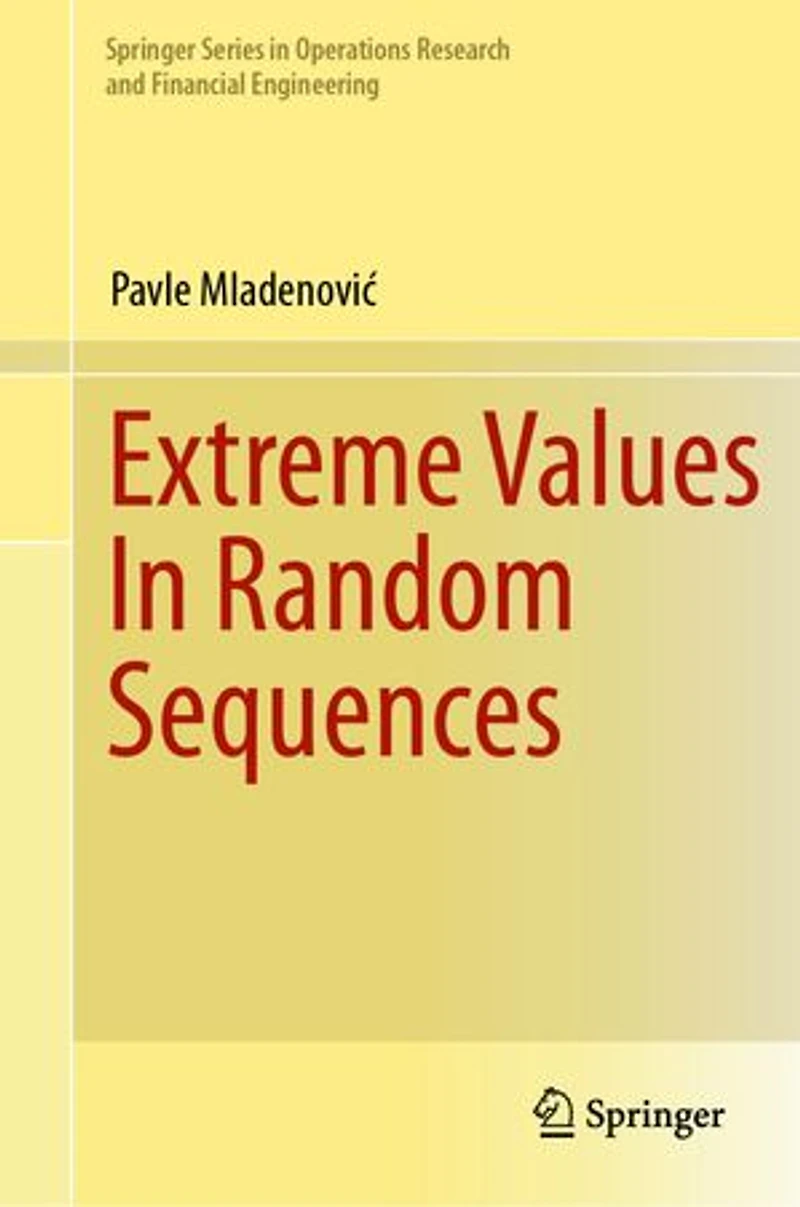
Extreme Values Random Sequences
Current price: $170.99
Original price: $212.99

Extreme Values Random Sequences
Current price: $170.99
Original price: $212.99
Loading Inventory...
Size: Kobo eBook
*Product information may vary - to confirm product availability, pricing, shipping and return information please contact Indigo
The main subject is the probabilistic extreme value theory. The purpose is to present recent results related to limiting distributions of maxima in incomplete samples from stationary sequences, and results related to extremal properties of different combinatorial configurations. The necessary contents related to regularly varying functions and basic results of extreme value theory are included in the first two chapters with examples, exercises and supplements. The motivation for consideration maxima in incomplete samples arises from the fact that real data are often incomplete. A sequence of observed random variables from a stationary sequence is also stationary only in very special cases. Hence, the results provided in the third chapter are also related to non-stationary sequences. The proof of theorems related to joint limiting distribution of maxima in complete and incomplete samples requires a non-trivial combination of combinatorics and point process theory. Chapter four provides results on the asymptotic behavior of the extremal characteristics of random permutations, the coupon collector's problem, the polynomial scheme, random trees and random forests, random partitions of finite sets, and the geometric properties of samples of random vectors. The topics presented here provide insight into the natural connections between probability theory and algebra, combinatorics, graph theory and combinatorial geometry. The contents of the book may be useful for graduate students and researchers who are interested in probabilistic extreme value theory and its applications.
The main subject is the probabilistic extreme value theory. The purpose is to present recent results related to limiting distributions of maxima in incomplete samples from stationary sequences, and results related to extremal properties of different combinatorial configurations. The necessary contents related to regularly varying functions and basic results of extreme value theory are included in the first two chapters with examples, exercises and supplements. The motivation for consideration maxima in incomplete samples arises from the fact that real data are often incomplete. A sequence of observed random variables from a stationary sequence is also stationary only in very special cases. Hence, the results provided in the third chapter are also related to non-stationary sequences. The proof of theorems related to joint limiting distribution of maxima in complete and incomplete samples requires a non-trivial combination of combinatorics and point process theory. Chapter four provides results on the asymptotic behavior of the extremal characteristics of random permutations, the coupon collector's problem, the polynomial scheme, random trees and random forests, random partitions of finite sets, and the geometric properties of samples of random vectors. The topics presented here provide insight into the natural connections between probability theory and algebra, combinatorics, graph theory and combinatorial geometry. The contents of the book may be useful for graduate students and researchers who are interested in probabilistic extreme value theory and its applications.
You May Also Like









More About Indigo at Erin Mills Town Centre
The largest book retailer in Canada also offers toys, music, home décor, gifts and lifestyle products. What's Inside...Books, Magazines, CD’s and DVD’s, Toys and Gifts, Home Accents, Electronics, Baby’s and Children’s Section, Bath and Body, Kitchen and Bedroom, Stationary Located outside in the exterior plaza.
5015 Glen Erin Dr, Mississauga, ON L5M 0R7, Canada
Find Indigo at Erin Mills Town Centre in Mississauga ON
Visit Indigo at Erin Mills Town Centre in Mississauga ON