

GIVE THE PERFECT GIFT
Erin Mills Town Centre Gift Cards are the perfect choice for your gift giving needs.Purchase gift cards at kiosks near the food court or centre court, at Guest Services, or click below to purchase online.PURCHASE HEREHome
High Fidelity Haptic Rendering
Indigo
Loading Inventory...
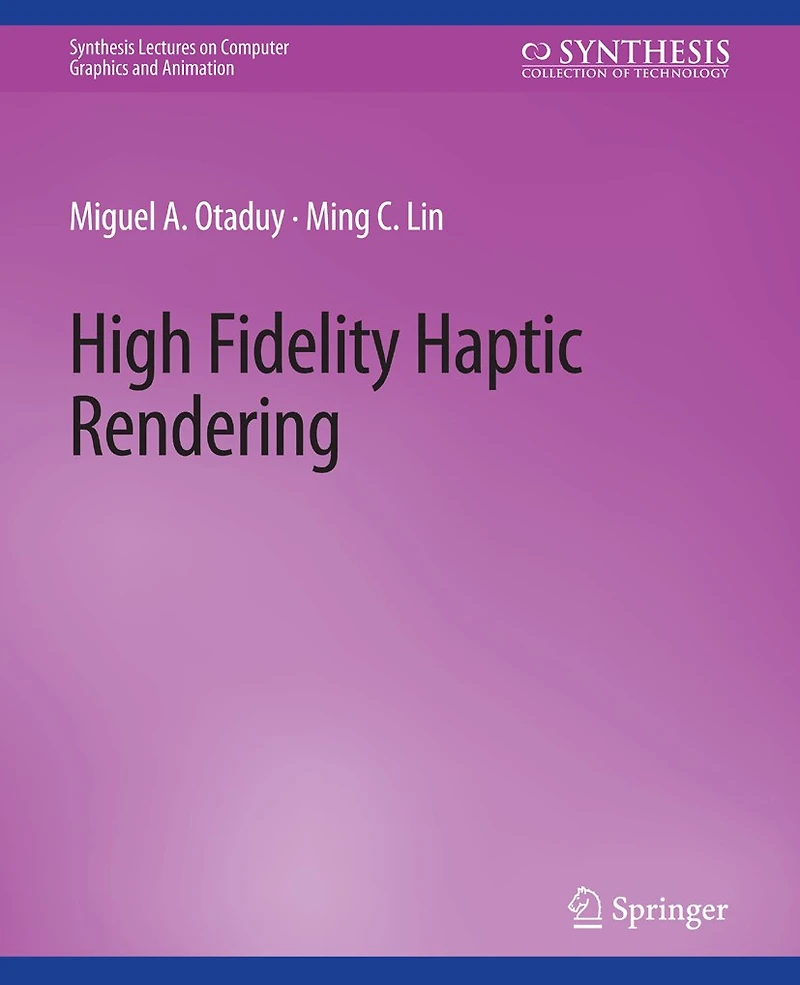
High Fidelity Haptic Rendering
Current price: $49.50

High Fidelity Haptic Rendering
Current price: $49.50
Loading Inventory...
Size: Paperback
*Product information may vary - to confirm product availability, pricing, shipping and return information please contact Indigo
The human haptic system, among all senses, provides unique and bidirectional communication between humans and their physical environment. Yet, to date, most human-computer interactive systems have focused primarily on the graphical rendering of visual information and, to a lesser extent, on the display of auditory information. Extending the frontier of visual computing, haptic interfaces, or force feedback devices, have the potential to increase the quality of human-computer interaction by accommodating the sense of touch. They provide an attractive augmentation to visual display and enhance the level of understanding of complex data sets. They have been effectively used for a number of applications including molecular docking, manipulation of nano-materials, surgical training, virtual prototyping, and digital sculpting. Compared with visual and auditory display, haptic rendering has extremely demanding computational requirements. In order to maintain a stable system while displaying smooth and realistic forces and torques, high haptic update rates in the range of 500-1000 Hz or more are typically used. Haptics present many new challenges to researchers and developers in computer graphics and interactive techniques. Some of the critical issues include the development of novel data structures to encode shape and material properties, as well as new techniques for geometry processing, data analysis, physical modeling, and haptic visualization. This synthesis examines some of the latest developments on haptic rendering, while looking forward to exciting future research in this area. It presents novel haptic rendering algorithms that take advantage of the human haptic sensory modality. Specifically it discusses different rendering techniques for various geometric representations (e.g. point-based, polygonal, multiresolution, distance fields, etc), as well as textured surfaces. It also shows how psychophysics of touch can provide the foundational design guidelines for developing perceptually driven force models and concludes with possible applications and issues to consider in future algorithmic design, validating rendering techniques, and evaluating haptic interfaces.
The human haptic system, among all senses, provides unique and bidirectional communication between humans and their physical environment. Yet, to date, most human-computer interactive systems have focused primarily on the graphical rendering of visual information and, to a lesser extent, on the display of auditory information. Extending the frontier of visual computing, haptic interfaces, or force feedback devices, have the potential to increase the quality of human-computer interaction by accommodating the sense of touch. They provide an attractive augmentation to visual display and enhance the level of understanding of complex data sets. They have been effectively used for a number of applications including molecular docking, manipulation of nano-materials, surgical training, virtual prototyping, and digital sculpting. Compared with visual and auditory display, haptic rendering has extremely demanding computational requirements. In order to maintain a stable system while displaying smooth and realistic forces and torques, high haptic update rates in the range of 500-1000 Hz or more are typically used. Haptics present many new challenges to researchers and developers in computer graphics and interactive techniques. Some of the critical issues include the development of novel data structures to encode shape and material properties, as well as new techniques for geometry processing, data analysis, physical modeling, and haptic visualization. This synthesis examines some of the latest developments on haptic rendering, while looking forward to exciting future research in this area. It presents novel haptic rendering algorithms that take advantage of the human haptic sensory modality. Specifically it discusses different rendering techniques for various geometric representations (e.g. point-based, polygonal, multiresolution, distance fields, etc), as well as textured surfaces. It also shows how psychophysics of touch can provide the foundational design guidelines for developing perceptually driven force models and concludes with possible applications and issues to consider in future algorithmic design, validating rendering techniques, and evaluating haptic interfaces.
You May Also Like















More About Indigo at Erin Mills Town Centre
The largest book retailer in Canada also offers toys, music, home décor, gifts and lifestyle products. What's Inside...Books, Magazines, CD’s and DVD’s, Toys and Gifts, Home Accents, Electronics, Baby’s and Children’s Section, Bath and Body, Kitchen and Bedroom, Stationary Located outside in the exterior plaza.
5015 Glen Erin Dr, Mississauga, ON L5M 0R7, Canada
Find Indigo at Erin Mills Town Centre in Mississauga ON
Visit Indigo at Erin Mills Town Centre in Mississauga ON