

GIVE THE PERFECT GIFT
Erin Mills Town Centre Gift Cards are the perfect choice for your gift giving needs.Purchase gift cards at kiosks near the food court or centre court, at Guest Services, or click below to purchase online.PURCHASE HEREHome
Integration of World Knowledge for Natural Language Understanding
Indigo
Loading Inventory...
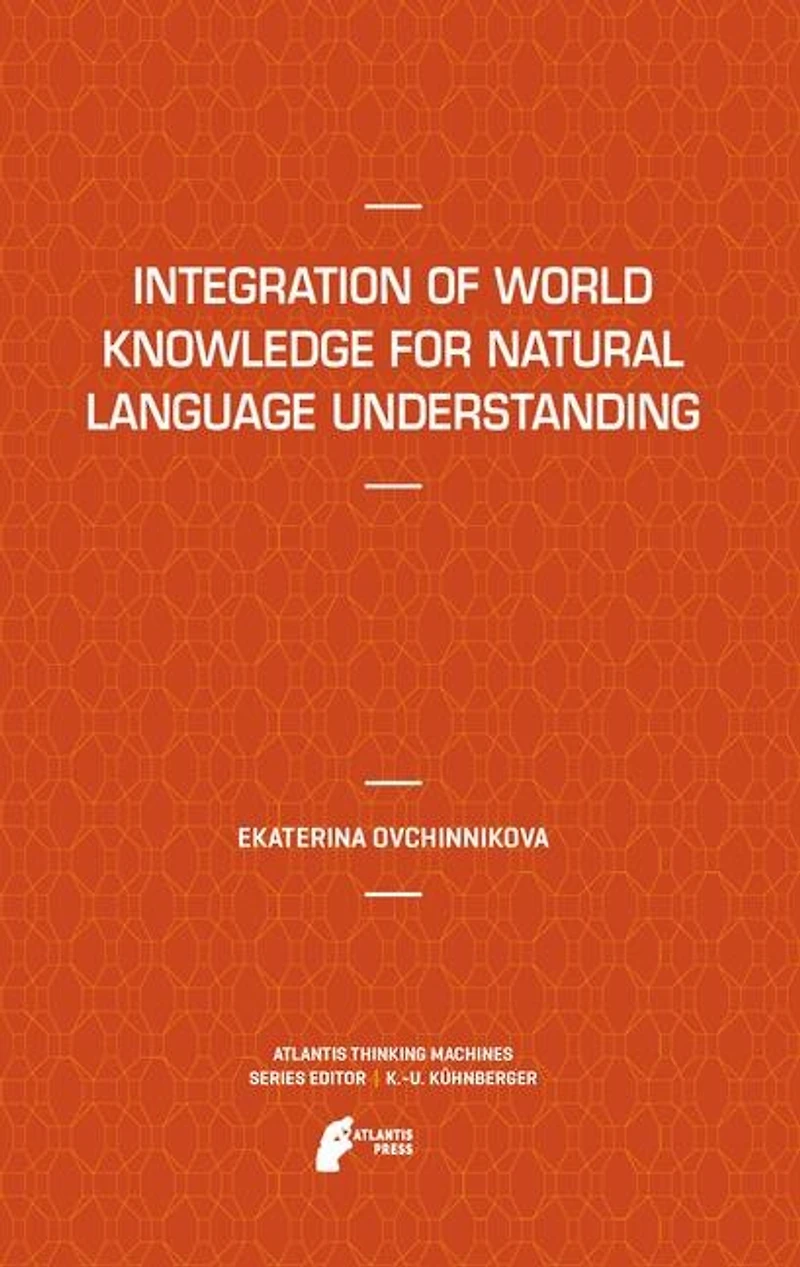
Integration of World Knowledge for Natural Language Understanding
Current price: $160.95

Integration of World Knowledge for Natural Language Understanding
Current price: $160.95
Loading Inventory...
Size: Hardcover
*Product information may vary - to confirm product availability, pricing, shipping and return information please contact Indigo
This book concerns non-linguistic knowledge required to perform computational natural language understanding (NLU). The main objective of the book is to show that inference-based NLU has the potential for practical large scale applications. First, an introduction to research areas relevant for NLU is given. We review approaches to linguistic meaning, explore knowledge resources, describe semantic parsers, and compare two main forms of inference: deduction and abduction. In the main part of the book, we propose an integrative knowledge base combining lexical-semantic, ontological, and distributional knowledge. A particular attention is payed to ensuring its consistency. We then design a reasoning procedure able to make use of the large scale knowledge base. We experiment both with a deduction-based NLU system and with an abductive reasoner. For evaluation, we use three different NLU tasks: recognizing textual entailment, semantic role labeling, and interpretation of noun dependencies.
This book concerns non-linguistic knowledge required to perform computational natural language understanding (NLU). The main objective of the book is to show that inference-based NLU has the potential for practical large scale applications. First, an introduction to research areas relevant for NLU is given. We review approaches to linguistic meaning, explore knowledge resources, describe semantic parsers, and compare two main forms of inference: deduction and abduction. In the main part of the book, we propose an integrative knowledge base combining lexical-semantic, ontological, and distributional knowledge. A particular attention is payed to ensuring its consistency. We then design a reasoning procedure able to make use of the large scale knowledge base. We experiment both with a deduction-based NLU system and with an abductive reasoner. For evaluation, we use three different NLU tasks: recognizing textual entailment, semantic role labeling, and interpretation of noun dependencies.
You May Also Like








More About Indigo at Erin Mills Town Centre
The largest book retailer in Canada also offers toys, music, home décor, gifts and lifestyle products. What's Inside...Books, Magazines, CD’s and DVD’s, Toys and Gifts, Home Accents, Electronics, Baby’s and Children’s Section, Bath and Body, Kitchen and Bedroom, Stationary Located outside in the exterior plaza.
5015 Glen Erin Dr, Mississauga, ON L5M 0R7, Canada
Find Indigo at Erin Mills Town Centre in Mississauga ON
Visit Indigo at Erin Mills Town Centre in Mississauga ON