

GIVE THE PERFECT GIFT
Erin Mills Town Centre Gift Cards are the perfect choice for your gift giving needs.Purchase gift cards at kiosks near the food court or centre court, at Guest Services, or click below to purchase online.PURCHASE HEREHome
Mathematical Foundations for Data Analysis
Indigo
Loading Inventory...
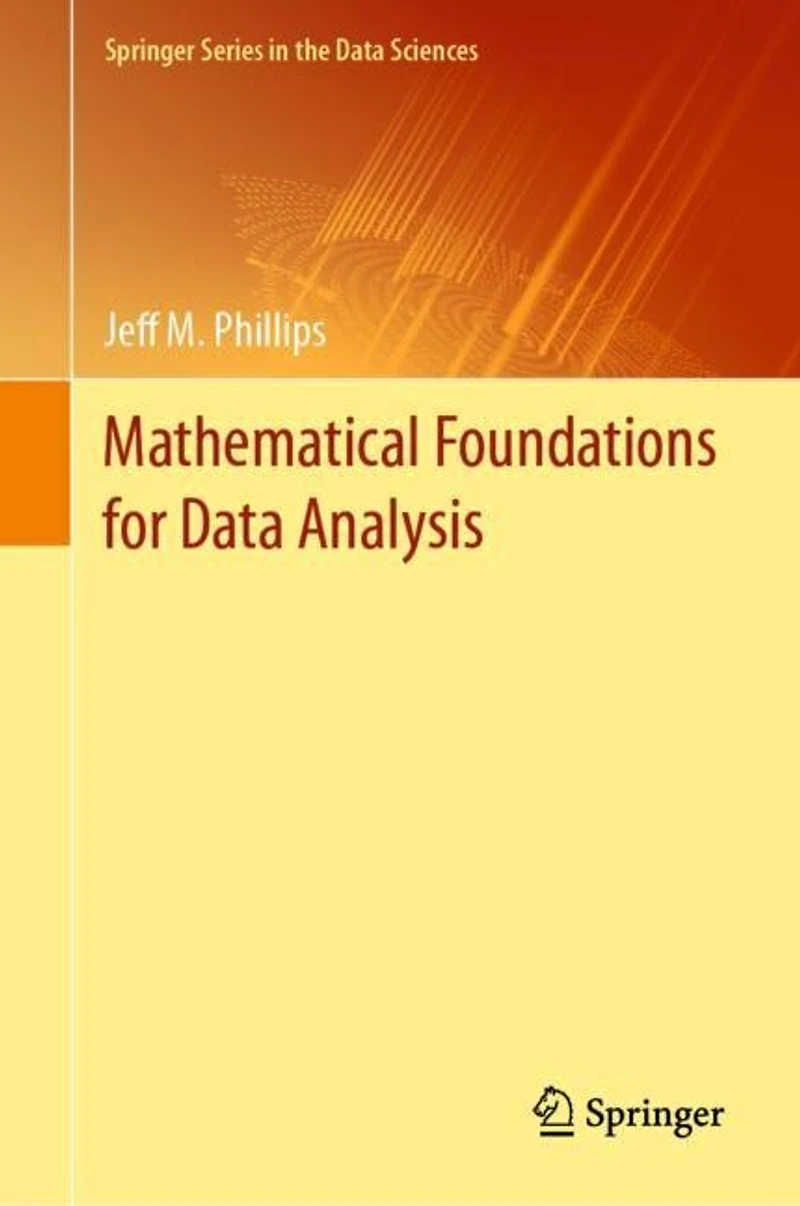
Mathematical Foundations for Data Analysis
Current price: $94.95

Mathematical Foundations for Data Analysis
Current price: $94.95
Loading Inventory...
Size: Hardcover
*Product information may vary - to confirm product availability, pricing, shipping and return information please contact Indigo
This textbook, suitable for an early undergraduate up to a graduate course, provides an overview of many basic principles and techniques needed for modern data analysis. In particular, this book was designed and written as preparation for students planning to take rigorous Machine Learning and Data Mining courses. It introduces key conceptual tools necessary for data analysis, including concentration of measure and PAC bounds, cross validation, gradient descent, and principal component analysis. It also surveys basic techniques in supervised (regression and classification) and unsupervised learning (dimensionality reduction and clustering) through an accessible, simplified presentation. Students are recommended to have some background in calculus, probability, and linear algebra. Some familiarity with programming and algorithms is useful to understand advanced topics on computational techniques.
This textbook, suitable for an early undergraduate up to a graduate course, provides an overview of many basic principles and techniques needed for modern data analysis. In particular, this book was designed and written as preparation for students planning to take rigorous Machine Learning and Data Mining courses. It introduces key conceptual tools necessary for data analysis, including concentration of measure and PAC bounds, cross validation, gradient descent, and principal component analysis. It also surveys basic techniques in supervised (regression and classification) and unsupervised learning (dimensionality reduction and clustering) through an accessible, simplified presentation. Students are recommended to have some background in calculus, probability, and linear algebra. Some familiarity with programming and algorithms is useful to understand advanced topics on computational techniques.
You May Also Like








More About Indigo at Erin Mills Town Centre
The largest book retailer in Canada also offers toys, music, home décor, gifts and lifestyle products. What's Inside...Books, Magazines, CD’s and DVD’s, Toys and Gifts, Home Accents, Electronics, Baby’s and Children’s Section, Bath and Body, Kitchen and Bedroom, Stationary Located outside in the exterior plaza.
5015 Glen Erin Dr, Mississauga, ON L5M 0R7, Canada
Find Indigo at Erin Mills Town Centre in Mississauga ON
Visit Indigo at Erin Mills Town Centre in Mississauga ON