

GIVE THE PERFECT GIFT
Erin Mills Town Centre Gift Cards are the perfect choice for your gift giving needs.Purchase gift cards at kiosks near the food court or centre court, at Guest Services, or click below to purchase online.PURCHASE HEREHome
Optical Communication Theory and Techniques by Enrico Forestieri, Hardcover | Indigo Chapters
Indigo
Loading Inventory...
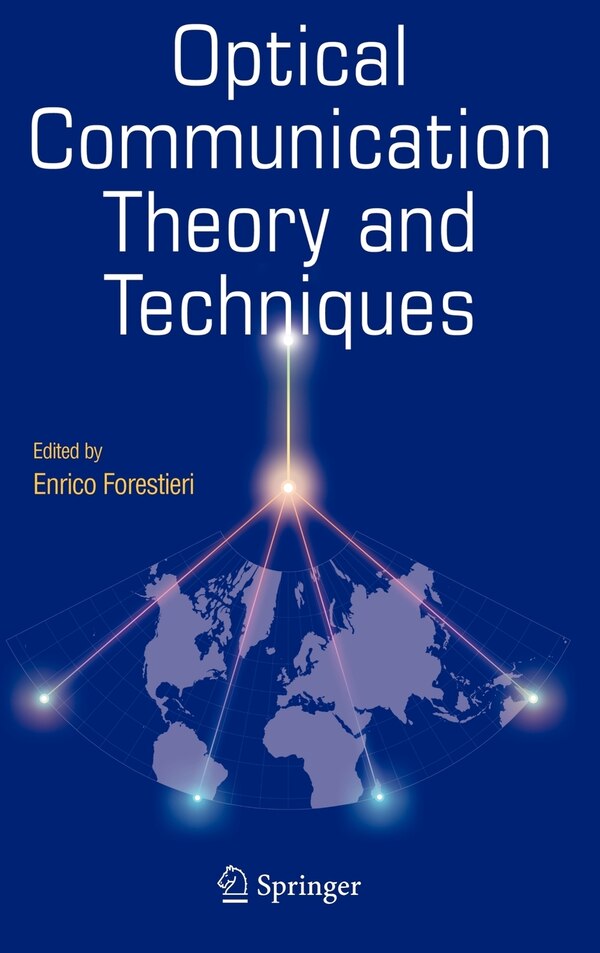
Optical Communication Theory and Techniques by Enrico Forestieri, Hardcover | Indigo Chapters
By Enrico Forestieri
Current price: $248.50

By Enrico Forestieri
Optical Communication Theory and Techniques by Enrico Forestieri, Hardcover | Indigo Chapters
Current price: $248.50
Loading Inventory...
Size: 1 x 9.25 x 2.45
*Product information may vary - to confirm product availability, pricing, shipping and return information please contact Indigo
Since the advent of optical communications, a greattechnological effort has been devoted to the exploitation of the huge bandwidth of optical fibers. Sta- ing from a few Mb/s single channel systems, a fast and constant technological development has led to the actual 10 Gb/s per channel dense wavelength - vision multiplexing (DWDM) systems, with dozens of channels on a single fiber. Transmitters and receivers are now ready for 40 Gb/s, whereas hundreds of channels can be simultaneously amplified by optical amplifiers. Nevertheless, despite such a pace in technological progress, optical c- munications are still in a primitive stage if compared, for instance, to radio communications: the widely spread on-off keying (OOK) modulation format is equivalent to the rough amplitude modulation (AM) format, whereas the DWDM technique is nothing more than the optical version of the frequency - vision multiplexing (FDM) technique. Moreover, adaptive equalization, ch- nel coding or maximum likelihood detection are still considered something exotic in the optical world. This is mainly due to the favourable char- teristics of the fiber optic channel (large bandwidth, low attenuation, channel stability, ...), which so far allowed us to use very simple transmission and detection techniques. | Optical Communication Theory and Techniques by Enrico Forestieri, Hardcover | Indigo Chapters
Since the advent of optical communications, a greattechnological effort has been devoted to the exploitation of the huge bandwidth of optical fibers. Sta- ing from a few Mb/s single channel systems, a fast and constant technological development has led to the actual 10 Gb/s per channel dense wavelength - vision multiplexing (DWDM) systems, with dozens of channels on a single fiber. Transmitters and receivers are now ready for 40 Gb/s, whereas hundreds of channels can be simultaneously amplified by optical amplifiers. Nevertheless, despite such a pace in technological progress, optical c- munications are still in a primitive stage if compared, for instance, to radio communications: the widely spread on-off keying (OOK) modulation format is equivalent to the rough amplitude modulation (AM) format, whereas the DWDM technique is nothing more than the optical version of the frequency - vision multiplexing (FDM) technique. Moreover, adaptive equalization, ch- nel coding or maximum likelihood detection are still considered something exotic in the optical world. This is mainly due to the favourable char- teristics of the fiber optic channel (large bandwidth, low attenuation, channel stability, ...), which so far allowed us to use very simple transmission and detection techniques. | Optical Communication Theory and Techniques by Enrico Forestieri, Hardcover | Indigo Chapters
You May Also Like








More About Indigo at Erin Mills Town Centre
The largest book retailer in Canada also offers toys, music, home décor, gifts and lifestyle products. What's Inside...Books, Magazines, CD’s and DVD’s, Toys and Gifts, Home Accents, Electronics, Baby’s and Children’s Section, Bath and Body, Kitchen and Bedroom, Stationary Located outside in the exterior plaza.
5015 Glen Erin Dr, Mississauga, ON L5M 0R7, Canada
Find Indigo at Erin Mills Town Centre in Mississauga ON
Visit Indigo at Erin Mills Town Centre in Mississauga ON