

GIVE THE PERFECT GIFT
Erin Mills Town Centre Gift Cards are the perfect choice for your gift giving needs.Purchase gift cards at kiosks near the food court or centre court, at Guest Services, or click below to purchase online.PURCHASE HEREHome
Processing Networks: Fluid Models And Stability
Indigo
Loading Inventory...
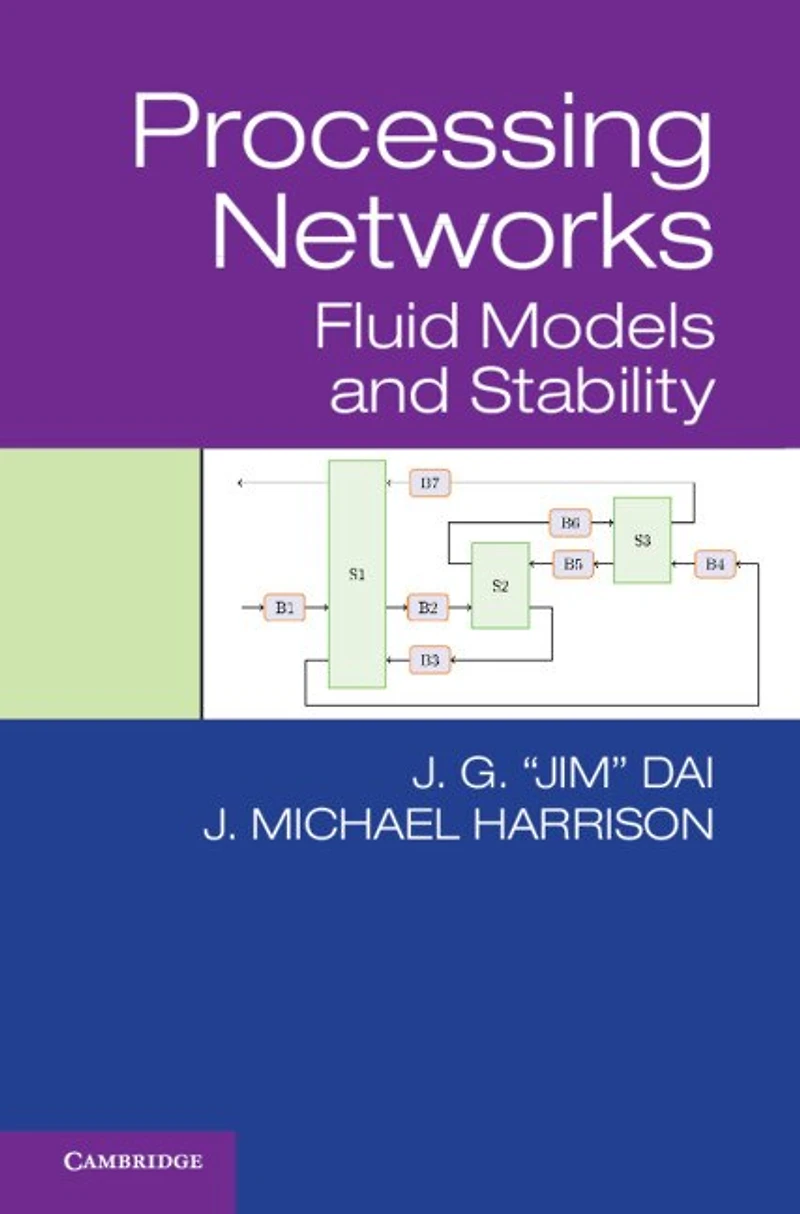
Processing Networks: Fluid Models And Stability
Current price: $81.95

Processing Networks: Fluid Models And Stability
Current price: $81.95
Loading Inventory...
Size: Hardcover
*Product information may vary - to confirm product availability, pricing, shipping and return information please contact Indigo
This state-of-the-art account unifies material developed in journal articles over the last 35 years, with two central thrusts: It describes a broad class of system models that the authors call 'stochastic processing networks' (SPNs), which include queueing networks and bandwidth sharing networks as prominent special cases; and in that context it explains and illustrates a method for stability analysis based on fluid models. The central mathematical result is a theorem that can be paraphrased as follows: If the fluid model derived from an SPN is stable, then the SPN itself is stable. Two topics discussed in detail are (a) the derivation of fluid models by means of fluid limit analysis, and (b) stability analysis for fluid models using Lyapunov functions. With regard to applications, there are chapters devoted to max-weight and back-pressure control, proportionally fair resource allocation, data center operations, and flow management in packet networks. Geared toward researchers and graduate students in engineering and applied mathematics, especially in electrical engineering and computer science, this compact text gives readers full command of the methods.
This state-of-the-art account unifies material developed in journal articles over the last 35 years, with two central thrusts: It describes a broad class of system models that the authors call 'stochastic processing networks' (SPNs), which include queueing networks and bandwidth sharing networks as prominent special cases; and in that context it explains and illustrates a method for stability analysis based on fluid models. The central mathematical result is a theorem that can be paraphrased as follows: If the fluid model derived from an SPN is stable, then the SPN itself is stable. Two topics discussed in detail are (a) the derivation of fluid models by means of fluid limit analysis, and (b) stability analysis for fluid models using Lyapunov functions. With regard to applications, there are chapters devoted to max-weight and back-pressure control, proportionally fair resource allocation, data center operations, and flow management in packet networks. Geared toward researchers and graduate students in engineering and applied mathematics, especially in electrical engineering and computer science, this compact text gives readers full command of the methods.
You May Also Like















More About Indigo at Erin Mills Town Centre
The largest book retailer in Canada also offers toys, music, home décor, gifts and lifestyle products. What's Inside...Books, Magazines, CD’s and DVD’s, Toys and Gifts, Home Accents, Electronics, Baby’s and Children’s Section, Bath and Body, Kitchen and Bedroom, Stationary Located outside in the exterior plaza.
5015 Glen Erin Dr, Mississauga, ON L5M 0R7, Canada
Find Indigo at Erin Mills Town Centre in Mississauga ON
Visit Indigo at Erin Mills Town Centre in Mississauga ON