

GIVE THE PERFECT GIFT
Erin Mills Town Centre Gift Cards are the perfect choice for your gift giving needs.Purchase gift cards at kiosks near the food court or centre court, at Guest Services, or click below to purchase online.PURCHASE HEREHome
Recurrent Event Modeling Based on the Yule Process: Application to Water Network Asset Management
Indigo
Loading Inventory...
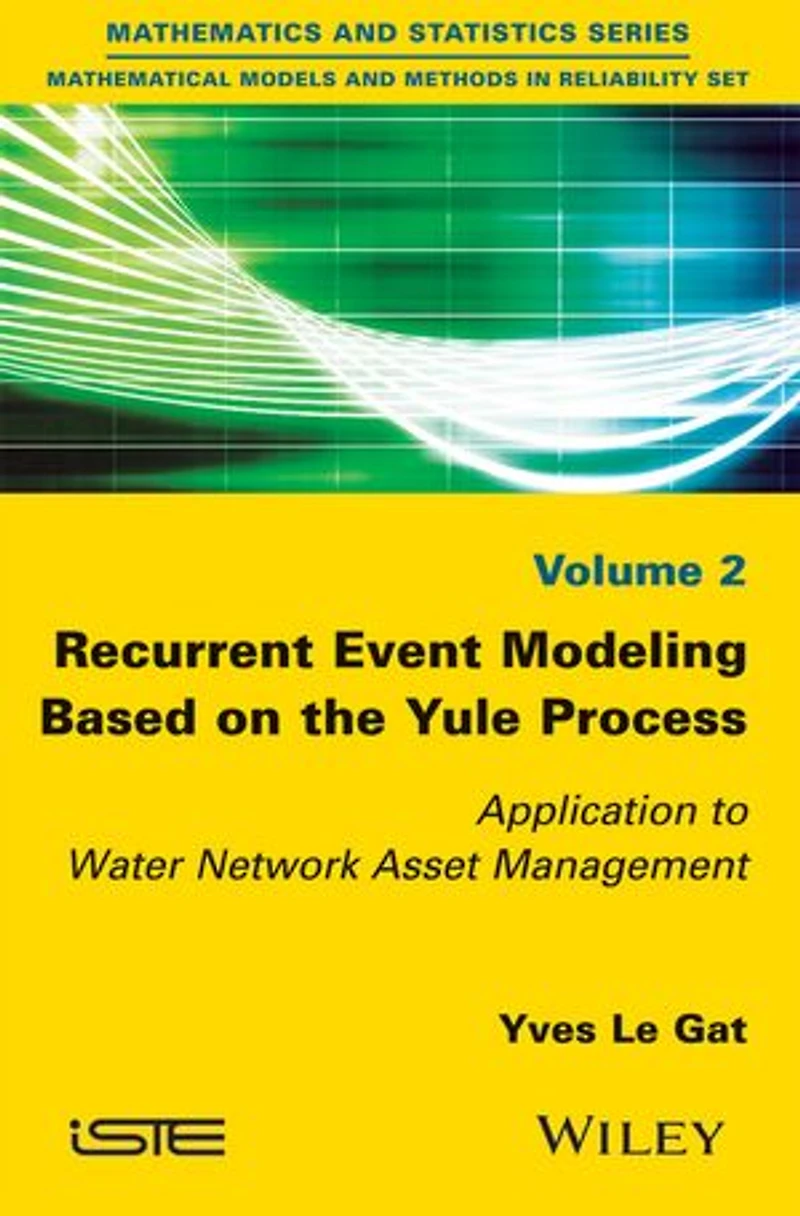
Recurrent Event Modeling Based on the Yule Process: Application to Water Network Asset Management
Current price: $174.99

Recurrent Event Modeling Based on the Yule Process: Application to Water Network Asset Management
Current price: $174.99
Loading Inventory...
Size: Kobo eBook
*Product information may vary - to confirm product availability, pricing, shipping and return information please contact Indigo
This book presents research work into the reliability of drinking water pipes. The infrastructure of water pipes is susceptible to routine failures, namely leakage or breakage, which occur in an aggregative manner in pipeline networks. Creating strategies for infrastructure asset management requires accurate modeling tools and first-hand experience of what repeated failures can mean in terms of socio-economic and environmental consequences. Devoted to the counting process framework when dealing with this issue, the author presents preliminary basic concepts, particularly the process intensity, as well as basic tools (classical distributions and processes). The introductory material precedes the discussion of several constructs, namely the non-homogeneous birth process, and further as a special case, the linearly extended Yule process (LEYP), and its adaptation to account for selective survival. The practical usefulness of the theoretical results is illustrated with actual water pipe failure data.
This book presents research work into the reliability of drinking water pipes. The infrastructure of water pipes is susceptible to routine failures, namely leakage or breakage, which occur in an aggregative manner in pipeline networks. Creating strategies for infrastructure asset management requires accurate modeling tools and first-hand experience of what repeated failures can mean in terms of socio-economic and environmental consequences. Devoted to the counting process framework when dealing with this issue, the author presents preliminary basic concepts, particularly the process intensity, as well as basic tools (classical distributions and processes). The introductory material precedes the discussion of several constructs, namely the non-homogeneous birth process, and further as a special case, the linearly extended Yule process (LEYP), and its adaptation to account for selective survival. The practical usefulness of the theoretical results is illustrated with actual water pipe failure data.
You May Also Like








More About Indigo at Erin Mills Town Centre
The largest book retailer in Canada also offers toys, music, home décor, gifts and lifestyle products. What's Inside...Books, Magazines, CD’s and DVD’s, Toys and Gifts, Home Accents, Electronics, Baby’s and Children’s Section, Bath and Body, Kitchen and Bedroom, Stationary Located outside in the exterior plaza.
5015 Glen Erin Dr, Mississauga, ON L5M 0R7, Canada
Find Indigo at Erin Mills Town Centre in Mississauga ON
Visit Indigo at Erin Mills Town Centre in Mississauga ON