

GIVE THE PERFECT GIFT
Erin Mills Town Centre Gift Cards are the perfect choice for your gift giving needs.Purchase gift cards at kiosks near the food court or centre court, at Guest Services, or click below to purchase online.PURCHASE HEREHome
Reduction And Predictability Of Natural Disasters by John Rundle, Paperback | Indigo Chapters
Indigo
Loading Inventory...
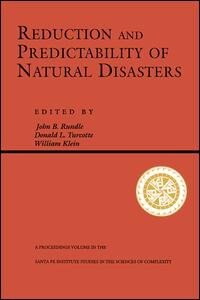
Reduction And Predictability Of Natural Disasters by John Rundle, Paperback | Indigo Chapters
By John Rundle
Current price: $92.50

By John Rundle
Reduction And Predictability Of Natural Disasters by John Rundle, Paperback | Indigo Chapters
Current price: $92.50
Loading Inventory...
Size: 0.67 x 9.21 x 1
*Product information may vary - to confirm product availability, pricing, shipping and return information please contact Indigo
Within the past five years, the international community has recognized that it may be possible, through programs of systematic study, to devise means to reduce and mitigate the occurrence of a variety of devastating natural hazards. Among these disasters are earthquakes, volcanic eruptions, floods, and landslides. The importance of these studies is underscored by the fact that within fifty years, more than a third of the world's population will live in seismically and volcanically active zones. The International Council of Scientific Unions, together with UNESCO and the World Bank, have therefore endorsed the 1990s as the International Decade of Natural Disaster Reduction (IDNDR), and are planning a variety of programs to address problems related to the predictability and mitigation of these disasters, particularly in third-world countries. Parallel programs have begun in a number of U. S. agencies. One of the most promising scientific avenues is to develop the capability to simulate these physical processes in the computer, Many of the recent models are nonlinear in significant ways, for example cellular automata or fractal growth models. They can thus be analyzed in a framework familiar to workers in complex system theory. It is often the case that the occurrence frequency of disaster events generated by the models follow power laws, perhaps with cutoffs. Thus there is a spectrum of event sizes, from small to large, that are presumably related by the nonlinear dynamics of the process. Simulation techniques can be used to study the fundamental physics of the process. Simulation techniques can be used to study the fundamental physics of the process, and most importantly, to develop means to predict the patterns of occurrence of large events in the models and to identify precursory phenomena. | Reduction And Predictability Of Natural Disasters by John Rundle, Paperback | Indigo Chapters
Within the past five years, the international community has recognized that it may be possible, through programs of systematic study, to devise means to reduce and mitigate the occurrence of a variety of devastating natural hazards. Among these disasters are earthquakes, volcanic eruptions, floods, and landslides. The importance of these studies is underscored by the fact that within fifty years, more than a third of the world's population will live in seismically and volcanically active zones. The International Council of Scientific Unions, together with UNESCO and the World Bank, have therefore endorsed the 1990s as the International Decade of Natural Disaster Reduction (IDNDR), and are planning a variety of programs to address problems related to the predictability and mitigation of these disasters, particularly in third-world countries. Parallel programs have begun in a number of U. S. agencies. One of the most promising scientific avenues is to develop the capability to simulate these physical processes in the computer, Many of the recent models are nonlinear in significant ways, for example cellular automata or fractal growth models. They can thus be analyzed in a framework familiar to workers in complex system theory. It is often the case that the occurrence frequency of disaster events generated by the models follow power laws, perhaps with cutoffs. Thus there is a spectrum of event sizes, from small to large, that are presumably related by the nonlinear dynamics of the process. Simulation techniques can be used to study the fundamental physics of the process. Simulation techniques can be used to study the fundamental physics of the process, and most importantly, to develop means to predict the patterns of occurrence of large events in the models and to identify precursory phenomena. | Reduction And Predictability Of Natural Disasters by John Rundle, Paperback | Indigo Chapters
You May Also Like












More About Indigo at Erin Mills Town Centre
The largest book retailer in Canada also offers toys, music, home décor, gifts and lifestyle products. What's Inside...Books, Magazines, CD’s and DVD’s, Toys and Gifts, Home Accents, Electronics, Baby’s and Children’s Section, Bath and Body, Kitchen and Bedroom, Stationary Located outside in the exterior plaza.
5015 Glen Erin Dr, Mississauga, ON L5M 0R7, Canada
Find Indigo at Erin Mills Town Centre in Mississauga ON
Visit Indigo at Erin Mills Town Centre in Mississauga ON