

GIVE THE PERFECT GIFT
Erin Mills Town Centre Gift Cards are the perfect choice for your gift giving needs.Purchase gift cards at kiosks near the food court or centre court, at Guest Services, or click below to purchase online.PURCHASE HEREHome
Shadowing and Hyperbolicity
Indigo
Loading Inventory...
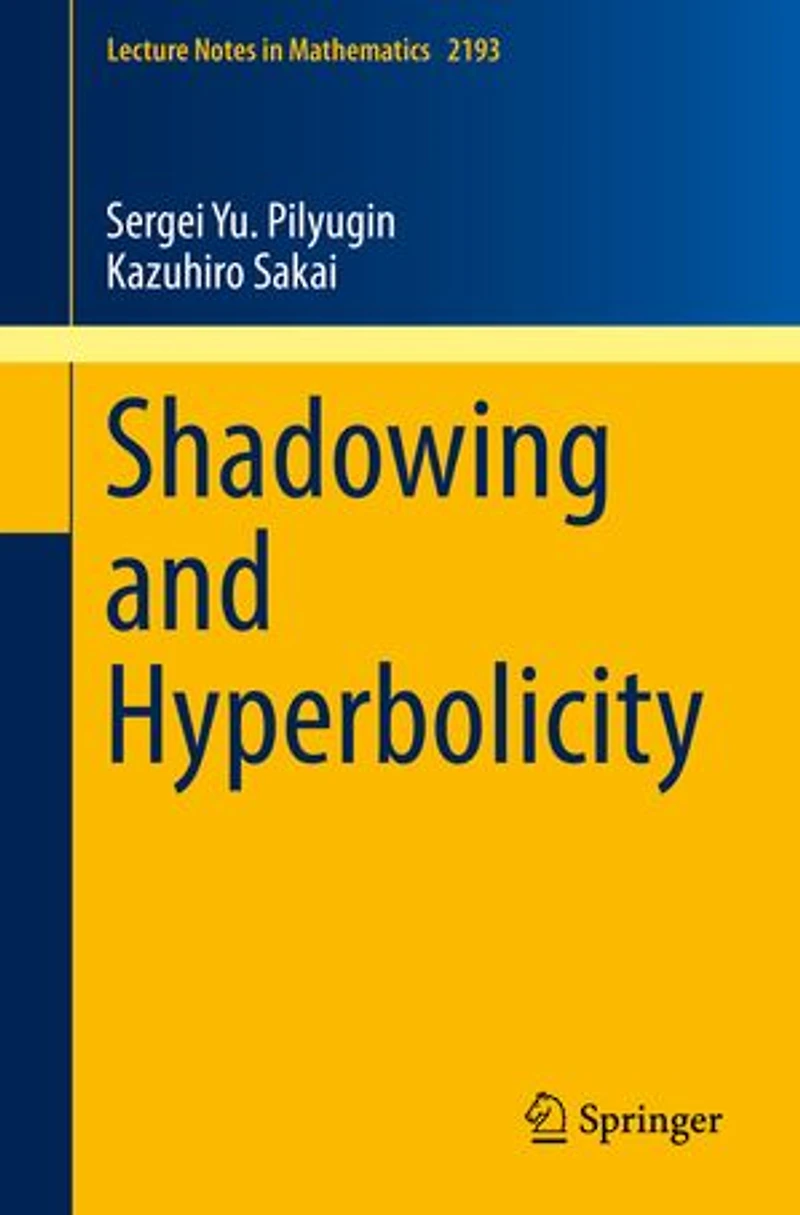
Shadowing and Hyperbolicity
Current price: $70.99
Original price: $88.68

Shadowing and Hyperbolicity
Current price: $70.99
Original price: $88.68
Loading Inventory...
Size: Kobo eBook
*Product information may vary - to confirm product availability, pricing, shipping and return information please contact Indigo
Focusing on the theory of shadowing of approximate trajectories (pseudotrajectories) of dynamical systems, this book surveys recent progress in establishing relations between shadowing and such basic notions from the classical theory of structural stability as hyperbolicity and transversality. Special attention is given to the study of "quantitative" shadowing properties, such as Lipschitz shadowing (it is shown that this property is equivalent to structural stability both for diffeomorphisms and smooth flows), and to the passage to robust shadowing (which is also equivalent to structural stability in the case of diffeomorphisms, while the situation becomes more complicated in the case of flows). Relations between the shadowing property of diffeomorphisms on their chain transitive sets and the hyperbolicity of such sets are also described. The book will allow young researchers in the field of dynamical systems to gain a better understanding of new ideas in the global qualitative theory. It will also be of interest to specialists in dynamical systems and their applications.
Focusing on the theory of shadowing of approximate trajectories (pseudotrajectories) of dynamical systems, this book surveys recent progress in establishing relations between shadowing and such basic notions from the classical theory of structural stability as hyperbolicity and transversality. Special attention is given to the study of "quantitative" shadowing properties, such as Lipschitz shadowing (it is shown that this property is equivalent to structural stability both for diffeomorphisms and smooth flows), and to the passage to robust shadowing (which is also equivalent to structural stability in the case of diffeomorphisms, while the situation becomes more complicated in the case of flows). Relations between the shadowing property of diffeomorphisms on their chain transitive sets and the hyperbolicity of such sets are also described. The book will allow young researchers in the field of dynamical systems to gain a better understanding of new ideas in the global qualitative theory. It will also be of interest to specialists in dynamical systems and their applications.
You May Also Like
















More About Indigo at Erin Mills Town Centre
The largest book retailer in Canada also offers toys, music, home décor, gifts and lifestyle products. What's Inside...Books, Magazines, CD’s and DVD’s, Toys and Gifts, Home Accents, Electronics, Baby’s and Children’s Section, Bath and Body, Kitchen and Bedroom, Stationary Located outside in the exterior plaza.
5015 Glen Erin Dr, Mississauga, ON L5M 0R7, Canada
Find Indigo at Erin Mills Town Centre in Mississauga ON
Visit Indigo at Erin Mills Town Centre in Mississauga ON