

GIVE THE PERFECT GIFT
Erin Mills Town Centre Gift Cards are the perfect choice for your gift giving needs.Purchase gift cards at kiosks near the food court or centre court, at Guest Services, or click below to purchase online.PURCHASE HEREHome
Sports Leagues Scheduling: Models, Combinatorial Properties, and Optimization Algorithms
Indigo
Loading Inventory...
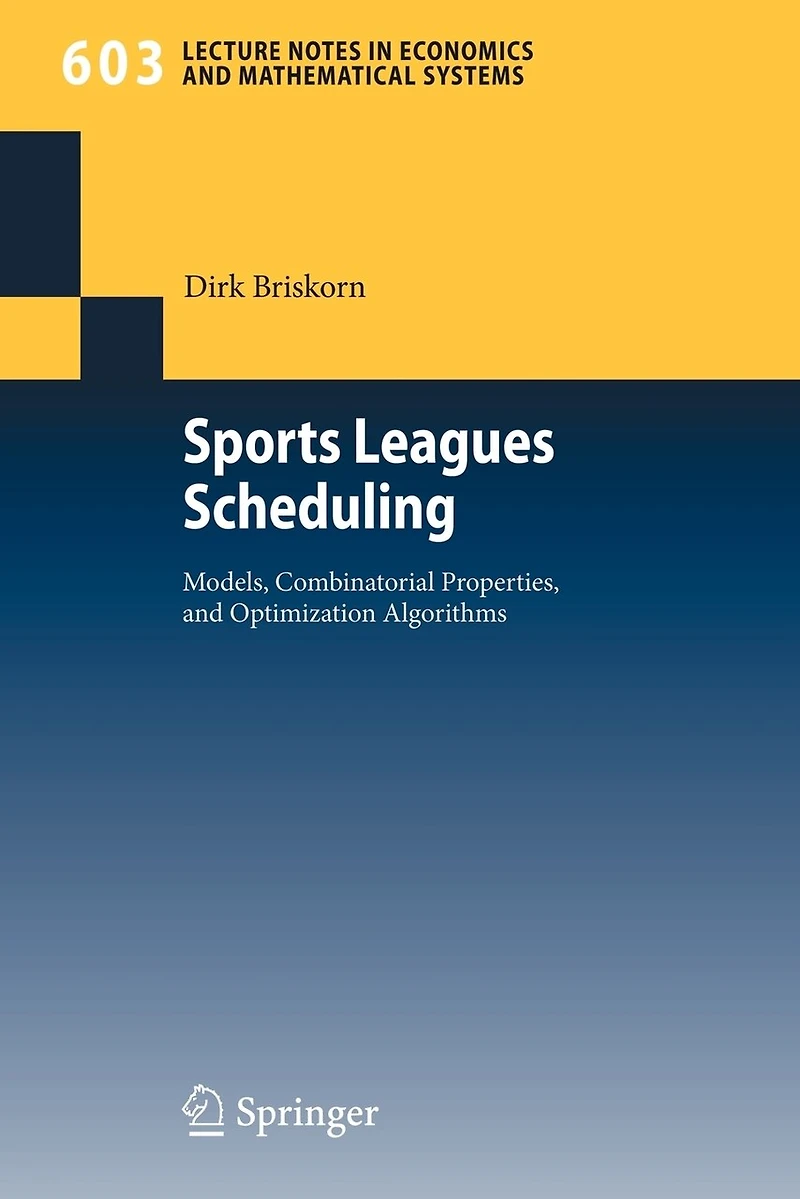
Sports Leagues Scheduling: Models, Combinatorial Properties, and Optimization Algorithms
Current price: $160.95

Sports Leagues Scheduling: Models, Combinatorial Properties, and Optimization Algorithms
Current price: $160.95
Loading Inventory...
Size: Paperback
*Product information may vary - to confirm product availability, pricing, shipping and return information please contact Indigo
In the context of sports leagues scheduling (SLS) several groups' interests must be taken into account. This book treats requirements for sport leagues schedules to be realizable from an operational and a security point of view, attractive for spectators and tv channels, and fair for the conampeting teams. Formal problem definitions as well as integer programming models are presented and analyzed. Additionally, several fairness concepts are developed and their operability is investigated by means of graph theory. Moreover, this book presents algorithmic concepts that can be drawn upon to construct suitable schedules. This volume provides a deep understanding of problems arising in the context of SLS as well as approaches for dealing with these problems, being relevant for both theoreticians and practitioners.
In the context of sports leagues scheduling (SLS) several groups' interests must be taken into account. This book treats requirements for sport leagues schedules to be realizable from an operational and a security point of view, attractive for spectators and tv channels, and fair for the conampeting teams. Formal problem definitions as well as integer programming models are presented and analyzed. Additionally, several fairness concepts are developed and their operability is investigated by means of graph theory. Moreover, this book presents algorithmic concepts that can be drawn upon to construct suitable schedules. This volume provides a deep understanding of problems arising in the context of SLS as well as approaches for dealing with these problems, being relevant for both theoreticians and practitioners.
You May Also Like








More About Indigo at Erin Mills Town Centre
The largest book retailer in Canada also offers toys, music, home décor, gifts and lifestyle products. What's Inside...Books, Magazines, CD’s and DVD’s, Toys and Gifts, Home Accents, Electronics, Baby’s and Children’s Section, Bath and Body, Kitchen and Bedroom, Stationary Located outside in the exterior plaza.
5015 Glen Erin Dr, Mississauga, ON L5M 0R7, Canada
Find Indigo at Erin Mills Town Centre in Mississauga ON
Visit Indigo at Erin Mills Town Centre in Mississauga ON