

GIVE THE PERFECT GIFT
Erin Mills Town Centre Gift Cards are the perfect choice for your gift giving needs.Purchase gift cards at kiosks near the food court or centre court, at Guest Services, or click below to purchase online.PURCHASE HEREHome
The Euclidean Programme
Indigo
Loading Inventory...
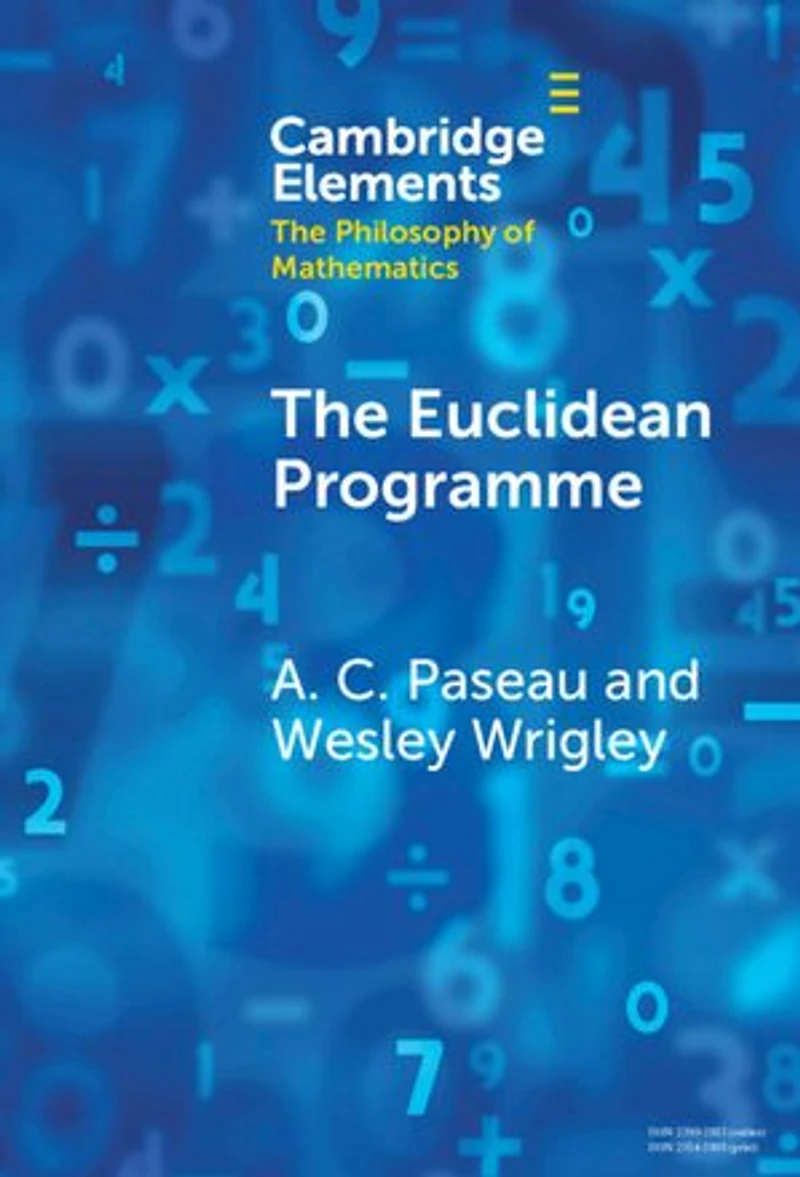
The Euclidean Programme
Current price: $23.19
Original price: $28.95

The Euclidean Programme
Current price: $23.19
Original price: $28.95
Loading Inventory...
Size: Kobo eBook
*Product information may vary - to confirm product availability, pricing, shipping and return information please contact Indigo
The Euclidean Programme embodies a traditional sort of epistemological foundationalism, according to which knowledge – especially mathematical knowledge – is obtained by deduction from self-evident axioms or first principles. Epistemologists have examined foundationalism extensively, but neglected its historically dominant Euclidean form. By contrast, this book offers a detailed examination of Euclidean foundationalism, which, following Lakatos, the authors call the Euclidean Programme. The book rationally reconstructs the programme's key principles, showing it to be an epistemological interpretation of the axiomatic method. It then compares the reconstructed programme with select historical sources: Euclid's Elements, Aristotle's Posterior Analytics, Descartes's Discourse on Method, Pascal's On the Geometric Mind and a twentieth-century account of axiomatisation. The second half of the book philosophically assesses the programme, exploring whether various areas of contemporary mathematics conform to it. The book concludes by outlining a replacement for the Euclidean Programme.
The Euclidean Programme embodies a traditional sort of epistemological foundationalism, according to which knowledge – especially mathematical knowledge – is obtained by deduction from self-evident axioms or first principles. Epistemologists have examined foundationalism extensively, but neglected its historically dominant Euclidean form. By contrast, this book offers a detailed examination of Euclidean foundationalism, which, following Lakatos, the authors call the Euclidean Programme. The book rationally reconstructs the programme's key principles, showing it to be an epistemological interpretation of the axiomatic method. It then compares the reconstructed programme with select historical sources: Euclid's Elements, Aristotle's Posterior Analytics, Descartes's Discourse on Method, Pascal's On the Geometric Mind and a twentieth-century account of axiomatisation. The second half of the book philosophically assesses the programme, exploring whether various areas of contemporary mathematics conform to it. The book concludes by outlining a replacement for the Euclidean Programme.
You May Also Like








More About Indigo at Erin Mills Town Centre
The largest book retailer in Canada also offers toys, music, home décor, gifts and lifestyle products. What's Inside...Books, Magazines, CD’s and DVD’s, Toys and Gifts, Home Accents, Electronics, Baby’s and Children’s Section, Bath and Body, Kitchen and Bedroom, Stationary Located outside in the exterior plaza.
5015 Glen Erin Dr, Mississauga, ON L5M 0R7, Canada
Find Indigo at Erin Mills Town Centre in Mississauga ON
Visit Indigo at Erin Mills Town Centre in Mississauga ON