

GIVE THE PERFECT GIFT
Erin Mills Town Centre Gift Cards are the perfect choice for your gift giving needs.Purchase gift cards at kiosks near the food court or centre court, at Guest Services, or click below to purchase online.PURCHASE HEREHome
The Morphosyntax of Negative Markers: A Nanosyntactic Account
Indigo
Loading Inventory...
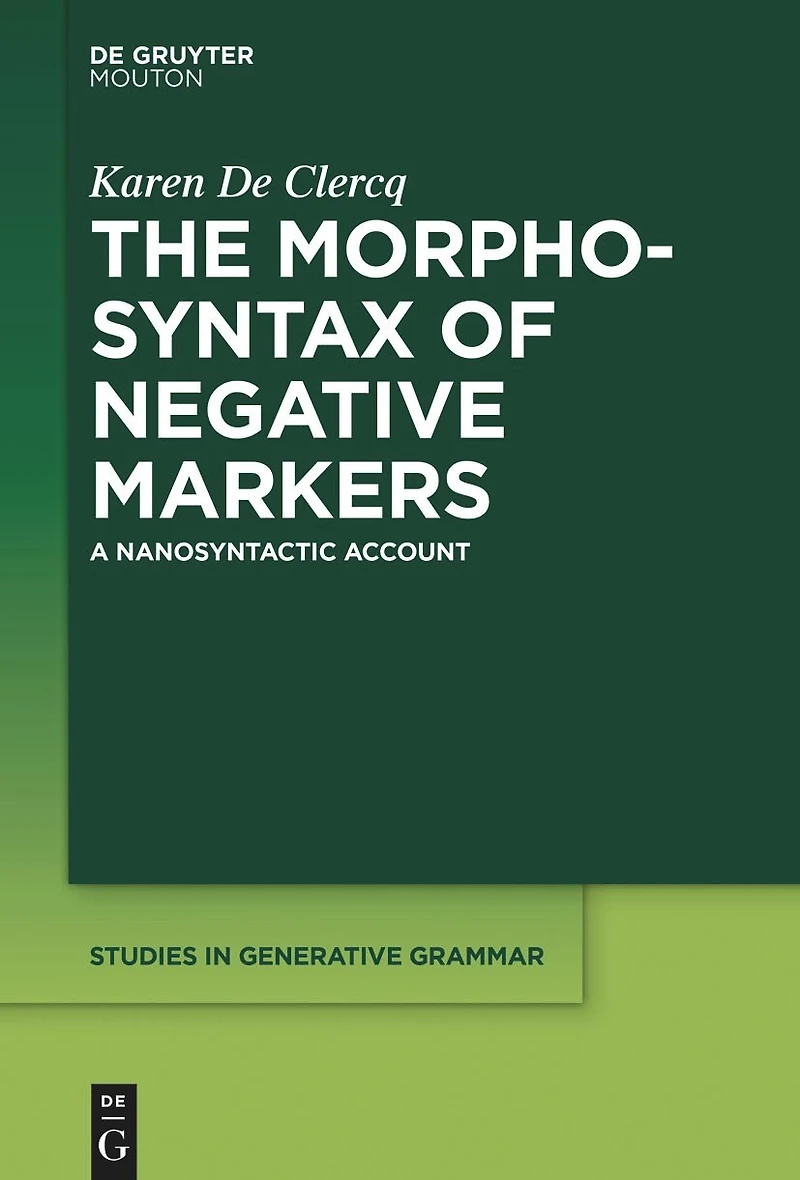
The Morphosyntax of Negative Markers: A Nanosyntactic Account
Current price: $254.99

The Morphosyntax of Negative Markers: A Nanosyntactic Account
Current price: $254.99
Loading Inventory...
Size: Hardcover
*Product information may vary - to confirm product availability, pricing, shipping and return information please contact Indigo
This book applies the tools of nanosyntax to the natural language phenomenon of negation. Most work on negation is concerned with the study of sentence negation, while low scope negation or constituent negation is hardly ever systematically discussed in the literature. The present book aims to fill that gap, by investigating scopally different negative markers in a sample of 23 typologically diverse languages. A four-way classification of negative markers is argued for and it is shown how meaningful syncretism patterns arise across those four groups of negative markers in the language sample investigated. The syncretisms are meaningful in that they track the natural semantic scope of negation, and provide support to the idea that morphology is not arbitrary, but points to submorphemic structure. Consequently, this study leads to a decomposition of the negative morpheme into five privative features: Tense, Focus, Classification, Quantity and Negation proper. Finally, the book argues that sentence, constituent and lexical negation can all be treated in the same module of the grammar, i.e. syntax.
This book applies the tools of nanosyntax to the natural language phenomenon of negation. Most work on negation is concerned with the study of sentence negation, while low scope negation or constituent negation is hardly ever systematically discussed in the literature. The present book aims to fill that gap, by investigating scopally different negative markers in a sample of 23 typologically diverse languages. A four-way classification of negative markers is argued for and it is shown how meaningful syncretism patterns arise across those four groups of negative markers in the language sample investigated. The syncretisms are meaningful in that they track the natural semantic scope of negation, and provide support to the idea that morphology is not arbitrary, but points to submorphemic structure. Consequently, this study leads to a decomposition of the negative morpheme into five privative features: Tense, Focus, Classification, Quantity and Negation proper. Finally, the book argues that sentence, constituent and lexical negation can all be treated in the same module of the grammar, i.e. syntax.
You May Also Like














More About Indigo at Erin Mills Town Centre
The largest book retailer in Canada also offers toys, music, home décor, gifts and lifestyle products. What's Inside...Books, Magazines, CD’s and DVD’s, Toys and Gifts, Home Accents, Electronics, Baby’s and Children’s Section, Bath and Body, Kitchen and Bedroom, Stationary Located outside in the exterior plaza.
5015 Glen Erin Dr, Mississauga, ON L5M 0R7, Canada
Find Indigo at Erin Mills Town Centre in Mississauga ON
Visit Indigo at Erin Mills Town Centre in Mississauga ON