

GIVE THE PERFECT GIFT
Erin Mills Town Centre Gift Cards are the perfect choice for your gift giving needs.Purchase gift cards at kiosks near the food court or centre court, at Guest Services, or click below to purchase online.PURCHASE HEREHome
The Theory That Would Not Die by Sharon Bertsch McGrayne, Paperback | Indigo Chapters
Indigo
Loading Inventory...
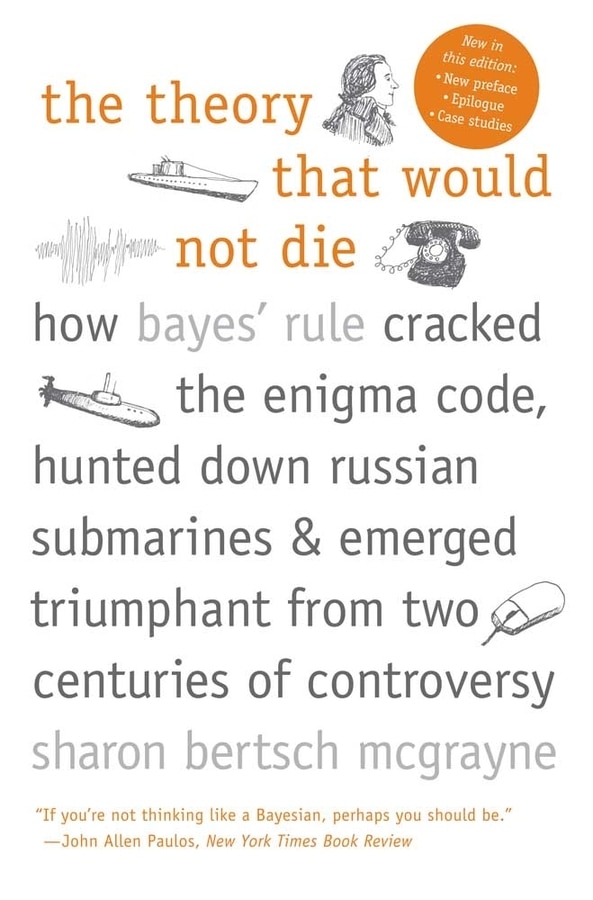
The Theory That Would Not Die by Sharon Bertsch McGrayne, Paperback | Indigo Chapters
By Sharon Bertsch McGrayne
Current price: $24.95

By Sharon Bertsch McGrayne
The Theory That Would Not Die by Sharon Bertsch McGrayne, Paperback | Indigo Chapters
Current price: $24.95
Loading Inventory...
Size: 1 x 9.25 x 1
*Product information may vary - to confirm product availability, pricing, shipping and return information please contact Indigo
A New York Times Book Review Editor's Choice: A vivid account of the generations-long dispute over Bayes' rule, one of the greatest breakthroughs in the history of applied mathematics and statisticsAn intellectual romp touching on, among other topics, military ingenuity, the origins of modern epidemiology, and the theological foundation of modern mathematics.—Michael Washburn, Boston GlobeTo have crafted a page-turner out of the history of statistics is an impressive feat. If only lectures at university had been this racy.—David Robson, New Scientist Bayes' rule appears to be a straightforward, one-line theorem: by updating our initial beliefs with objective new information, we get a new and improved belief. To its adherents, it is an elegant statement about learning from experience. To its opponents, it is subjectivity run amok. In the first-ever account of Bayes' rule for general readers, Sharon Bertsch McGrayne explores this controversial theorem and the human obsessions surrounding it. She traces its discovery by an amateur mathematician in the 1740s through its development into roughly its modern form by French scientist Pierre Simon Laplace. She reveals why respected statisticians rendered it professionally taboo for 150 years—at the same time that practitioners relied on it to solve crises involving great uncertainty and scanty information (Alan Turing's role in breaking Germany's Enigma code during World War II), and explains how the advent of off-the-shelf computer technology in the 1980s proved to be a game-changer. Today, Bayes' rule is used everywhere from DNA de-coding to Homeland Security. Drawing on primary source material and interviews with statisticians and other scientists, The Theory That Would Not Die is the riveting account of how a seemingly simple theorem ignited one of the greatest controversies of all time. | The Theory That Would Not Die by Sharon Bertsch McGrayne, Paperback | Indigo Chapters
A New York Times Book Review Editor's Choice: A vivid account of the generations-long dispute over Bayes' rule, one of the greatest breakthroughs in the history of applied mathematics and statisticsAn intellectual romp touching on, among other topics, military ingenuity, the origins of modern epidemiology, and the theological foundation of modern mathematics.—Michael Washburn, Boston GlobeTo have crafted a page-turner out of the history of statistics is an impressive feat. If only lectures at university had been this racy.—David Robson, New Scientist Bayes' rule appears to be a straightforward, one-line theorem: by updating our initial beliefs with objective new information, we get a new and improved belief. To its adherents, it is an elegant statement about learning from experience. To its opponents, it is subjectivity run amok. In the first-ever account of Bayes' rule for general readers, Sharon Bertsch McGrayne explores this controversial theorem and the human obsessions surrounding it. She traces its discovery by an amateur mathematician in the 1740s through its development into roughly its modern form by French scientist Pierre Simon Laplace. She reveals why respected statisticians rendered it professionally taboo for 150 years—at the same time that practitioners relied on it to solve crises involving great uncertainty and scanty information (Alan Turing's role in breaking Germany's Enigma code during World War II), and explains how the advent of off-the-shelf computer technology in the 1980s proved to be a game-changer. Today, Bayes' rule is used everywhere from DNA de-coding to Homeland Security. Drawing on primary source material and interviews with statisticians and other scientists, The Theory That Would Not Die is the riveting account of how a seemingly simple theorem ignited one of the greatest controversies of all time. | The Theory That Would Not Die by Sharon Bertsch McGrayne, Paperback | Indigo Chapters
You May Also Like












More About Indigo at Erin Mills Town Centre
The largest book retailer in Canada also offers toys, music, home décor, gifts and lifestyle products. What's Inside...Books, Magazines, CD’s and DVD’s, Toys and Gifts, Home Accents, Electronics, Baby’s and Children’s Section, Bath and Body, Kitchen and Bedroom, Stationary Located outside in the exterior plaza.
5015 Glen Erin Dr, Mississauga, ON L5M 0R7, Canada
Find Indigo at Erin Mills Town Centre in Mississauga ON
Visit Indigo at Erin Mills Town Centre in Mississauga ON