

GIVE THE PERFECT GIFT
Erin Mills Town Centre Gift Cards are the perfect choice for your gift giving needs.Purchase gift cards at kiosks near the food court or centre court, at Guest Services, or click below to purchase online.PURCHASE HEREHome
Theory of Duality in Mathematical Programming
Indigo
Loading Inventory...
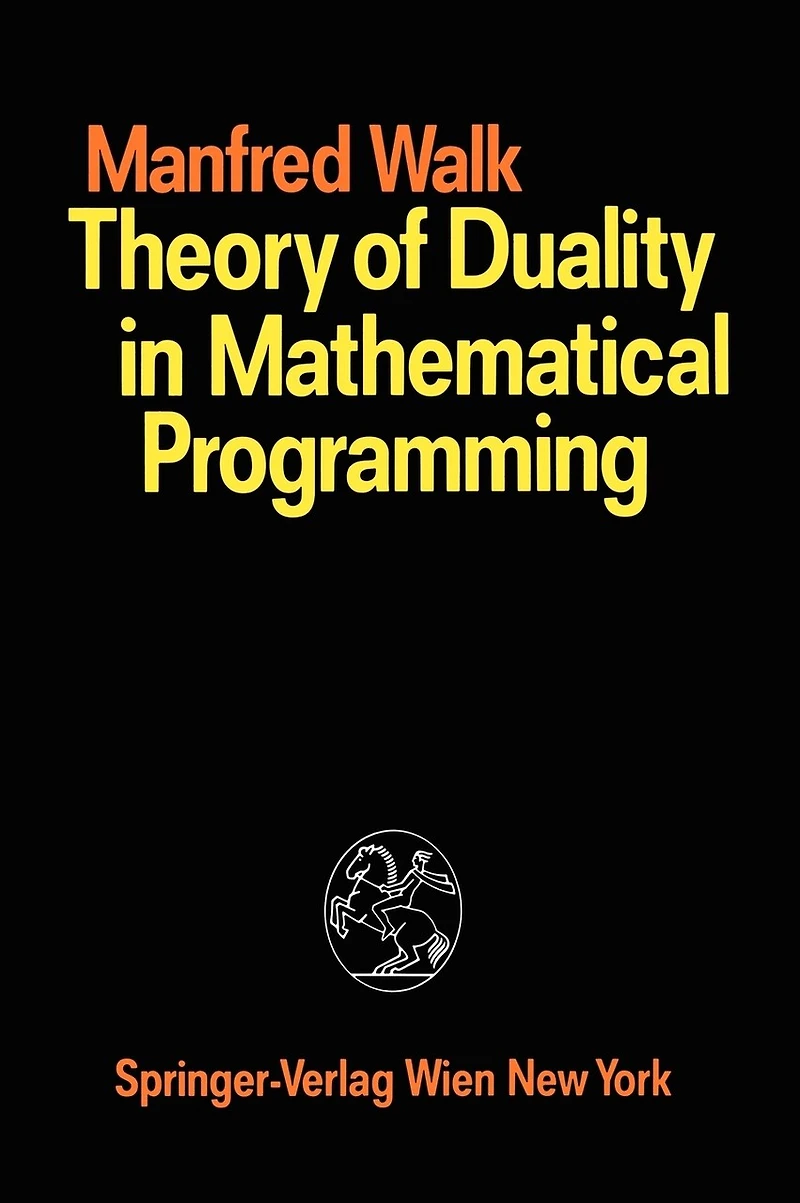
Theory of Duality in Mathematical Programming
Current price: $80.50

Theory of Duality in Mathematical Programming
Current price: $80.50
Loading Inventory...
Size: Hardcover
*Product information may vary - to confirm product availability, pricing, shipping and return information please contact Indigo
Courses on mathematical programming are now part of standard teaching programs of universities and institutes. The aim of this book is to introduce students of mathematics, economics, technology and other related subjects to the qualitative theory of mathematical programming in paired vector spaces. Prerequisite for the study of this book is only a basic knowledge of analysis, of elements of functional analysis and linear algebra. The application of elementary ideas of functional analysis is convenient for a more rigorous construction of proofs and for some generalizations of the finite dimensional theory on infinite dimensional Banach-spaces. An important feature of this book is the use of a principle of duality to formulate the theoretical basis of many different concrete programming problems. The main idea of the book is to present relations of duality and to construct a general theoretical basis for different special programming problems.
Courses on mathematical programming are now part of standard teaching programs of universities and institutes. The aim of this book is to introduce students of mathematics, economics, technology and other related subjects to the qualitative theory of mathematical programming in paired vector spaces. Prerequisite for the study of this book is only a basic knowledge of analysis, of elements of functional analysis and linear algebra. The application of elementary ideas of functional analysis is convenient for a more rigorous construction of proofs and for some generalizations of the finite dimensional theory on infinite dimensional Banach-spaces. An important feature of this book is the use of a principle of duality to formulate the theoretical basis of many different concrete programming problems. The main idea of the book is to present relations of duality and to construct a general theoretical basis for different special programming problems.
You May Also Like









More About Indigo at Erin Mills Town Centre
The largest book retailer in Canada also offers toys, music, home décor, gifts and lifestyle products. What's Inside...Books, Magazines, CD’s and DVD’s, Toys and Gifts, Home Accents, Electronics, Baby’s and Children’s Section, Bath and Body, Kitchen and Bedroom, Stationary Located outside in the exterior plaza.
5015 Glen Erin Dr, Mississauga, ON L5M 0R7, Canada
Find Indigo at Erin Mills Town Centre in Mississauga ON
Visit Indigo at Erin Mills Town Centre in Mississauga ON