

GIVE THE PERFECT GIFT
Erin Mills Town Centre Gift Cards are the perfect choice for your gift giving needs.Purchase gift cards at kiosks near the food court or centre court, at Guest Services, or click below to purchase online.PURCHASE HEREHome
Freedom and Self-Creation by Katherin A. Rogers, Hardcover | Indigo Chapters
Indigo
Loading Inventory...
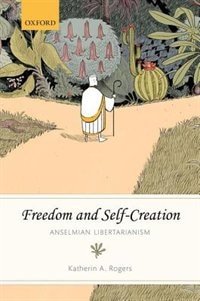
Freedom and Self-Creation by Katherin A. Rogers, Hardcover | Indigo Chapters
By Katherin A. Rogers
Current price: $139.94

By Katherin A. Rogers
Freedom and Self-Creation by Katherin A. Rogers, Hardcover | Indigo Chapters
Current price: $139.94
Loading Inventory...
Size: 20.29 x 234 x 540
*Product information may vary - to confirm product availability, pricing, shipping and return information please contact Indigo
Katherin A. Rogers presents a new theory of free will, based on the thought of Anselm of Canterbury. We did not originally produce ourselves. Yet, according to Anselm, we can engage in self-creation, freely and responsibly forming our characters by choosing from ourselves (a se) between openoptions. Anselm introduces a new, agent-causal libertarianism which is parsimonious in that, unlike other agent-causal theories, it does not appeal to any unique and mysterious powers to explain how the free agent chooses. After setting out Anselm's original theory, Rogers defends and develops it by addressing a series of standard problems levelled against libertarianism. These include the problem of internalism - in that an agent is not the source of his original motivations, how can the structure of his choiceground his responsibility?; the problem of Frankfurt-style counterexamples - Do we really need open options to choose freely?; and the problem of luck - If nothing about an agent before he chooses explains his choice, then isn't the choice just dumb luck? (The Anselmian answer to this perennialcriticism is especially innovative, proposing that the critic has the relationship between choices and character exactly backwards.) Finally, as a theory about self-creation, Anselmian Libertarianism must defend the tracing thesis, the claim that an agent can be responsible for character-determinedchoices, if he, himself, formed his character through earlier a se choices. Throughout, the book defends and exemplifies a new methodological suggestion: someone debating free will ought to make his background world view explicit. In the on-going debate over the possibility of human freedom and responsibility, Anselmian Libertarianism constitutes a new and plausibleapproach. | Freedom and Self-Creation by Katherin A. Rogers, Hardcover | Indigo Chapters
Katherin A. Rogers presents a new theory of free will, based on the thought of Anselm of Canterbury. We did not originally produce ourselves. Yet, according to Anselm, we can engage in self-creation, freely and responsibly forming our characters by choosing from ourselves (a se) between openoptions. Anselm introduces a new, agent-causal libertarianism which is parsimonious in that, unlike other agent-causal theories, it does not appeal to any unique and mysterious powers to explain how the free agent chooses. After setting out Anselm's original theory, Rogers defends and develops it by addressing a series of standard problems levelled against libertarianism. These include the problem of internalism - in that an agent is not the source of his original motivations, how can the structure of his choiceground his responsibility?; the problem of Frankfurt-style counterexamples - Do we really need open options to choose freely?; and the problem of luck - If nothing about an agent before he chooses explains his choice, then isn't the choice just dumb luck? (The Anselmian answer to this perennialcriticism is especially innovative, proposing that the critic has the relationship between choices and character exactly backwards.) Finally, as a theory about self-creation, Anselmian Libertarianism must defend the tracing thesis, the claim that an agent can be responsible for character-determinedchoices, if he, himself, formed his character through earlier a se choices. Throughout, the book defends and exemplifies a new methodological suggestion: someone debating free will ought to make his background world view explicit. In the on-going debate over the possibility of human freedom and responsibility, Anselmian Libertarianism constitutes a new and plausibleapproach. | Freedom and Self-Creation by Katherin A. Rogers, Hardcover | Indigo Chapters
You May Also Like







More About Indigo at Erin Mills Town Centre
The largest book retailer in Canada also offers toys, music, home décor, gifts and lifestyle products. What's Inside...Books, Magazines, CD’s and DVD’s, Toys and Gifts, Home Accents, Electronics, Baby’s and Children’s Section, Bath and Body, Kitchen and Bedroom, Stationary Located outside in the exterior plaza.
5015 Glen Erin Dr, Mississauga, ON L5M 0R7, Canada
Find Indigo at Erin Mills Town Centre in Mississauga ON
Visit Indigo at Erin Mills Town Centre in Mississauga ON